 |
|
When the Puritans landed in Boston in 1630, the Separatist settlement at Plymouth Colony was ten years old. Puritans and Separatists were two Protestant sects that developed in the late 16th century in England. Puritans were critical of, but remained part of, the Church of England. Separatists “separated” from the Church of England and, because of persecution, many moved to Leyden, Holland. In 1620 they sailed for New England. As the Puritan settlement in Boston grew from a village to a thriving port town, members of the Plymouth Colony moved to Boston to pursue their commerce.
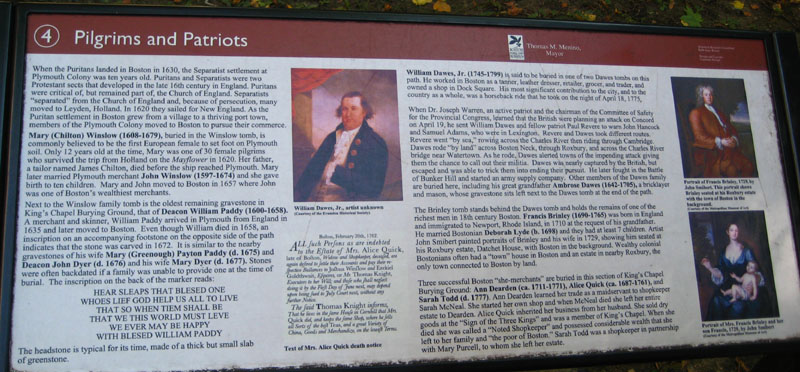
Mary (Chilton) Winslow (1608-1679), buried in the Winslow tomb, is commonly believed to be the first European female to set foot on Plymouth soil. Only 12 years old at the time, Mary was one of 30 female pilgrims who survived the trip from Holland on the Mayflower in 1620. Her father, a tailor named James Chilton, died before the ship reached Plymouth. Mary later married Plymouth merchant John Winslow (1597-1674) and she gave birth to ten children. Mary and John moved to Boston in 1657 where John was one of Boston’s wealthiest merchants.
Next to the Winslow family tomb is the oldest remaining gravestone in King’s Chapel Burying Ground, that of Deacon William Paddy (1600-1658). A merchant and skinner, William Paddy arrived in Plymouth from England in 1635 and later moved to Boston. Even though William died in 1658, an inscription on an accompanying footstone on the opposite side of the path indicates that the stone was carved in 1672. It is similar to the nearby gravestones of his wife Mary (Greenough) Payton Paddy (d. 1675) and Deacon John Dyer (d. 1676) and his wife Mary Dyer (d. 1677). Stones were often backdated if a family was unable to provide one at the time of burial. The inscription on the back of the marker reads:
|
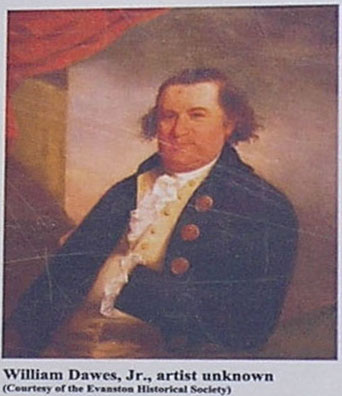
When Dr. Joseph Warren, an active patriot and the chairman of the Committee of Safety for the Provincial Congress, learned that the British were planning an attack on Concord on April 19, he sent William Dawes and fellow patriot Paul Revere to warn John Hancock and Samuel Adams, who were in Lexington. Revere and Dawes took different routes. Revere went “by sea,” rowing across the Charles River then riding through Cambridge. Dawes rode “by land” across Boston Neck, through Roxbury, and across the Charles River bridge near Watertown. As he rode, Dawes alerted towns of the impending attack giving them the chance to call out their militia. Dawes was nearly captured by the British, but escaped and was able to trick them into ending their pursuit. He later fought in the Battle of Bunker Hill and started an army supply company. Other members of the Dawes family are buried here, including his great grandfather Ambrose Dawes (1642-1705), a bricklayer and mason, whose gravestone sits left next to the Dawes tomb at the end of the path.
|
|