|
October 26 - November 17, 2024: Our Fall Trip to Florida |
|
September 6-9, 2024: San Antonio Birthdays |
|
Return to the Index for 2024 |
We are getting into a pattern now, vis-a-vis our house in Ecuador, and that pattern is to make three trips a year down there, staying about three weeks each time. The schedule for these trips this year has been in February, May, and now in October, and it looks as if we will maintain the same schedule until and unless we decide to move towards permanent residency in Ecuador. That decision will depend on a lot of factors, one major one of which will be coming up next month. But, for now, we are simply taking advantage of the fact that we have the house to head down there to spend some time.
Getting to the House in Ecuador
We are doing something different this time, and I'd like to say something about why.
|
On our first return from Ecuador, we were introduced to the confusion of Miami Airport Customs, which is busy no matter what time you arrive- even very early in the morning when the overnight flight from Quito gets in. On our second trip down there, we had done some homework, and discovered that Jet Blue flew from Fort Lauderdale to Quito, and that Jet Blue was an American Airline partner, such that my perks transferred over (free bag check, seat selection, priority boarding, etc.) So on our second trip, we took Jet Blue from Fort Lauderdale. (This actually enabled us to drive to Fort Lauderdale and incorporate the Ecuador trip into a trip to Florida.)
Customs on our return to Fort Lauderdale was a breeze, and so we thought we'd found a convenient way to bypass the zoo that is Miami International Airport. On the next trip down, I again booked Jet Blue, but the booking seemed different somehow, and it wasn't until after I'd purchased the nonrefundable ticket that I discovered that Jet Blue had severed its ties with American. I had to get on the phone with Jet Blue for that trip to arrange for complimentary bags and seat selection, but going forward, Jet Blue wouldn't be an option, as in fact they were discontinuing their flight from Fort Lauderdale to Quito anyway.
So on our next trip down, it was back to a one-stop, with that stop being Miami. This was the trip in February of this year, the one where my niece Jeffie visited, followed by our friend Brad. The return through Miami was as hectic as before, with the customs hall resembling the snaking waiting lines for an E-ticket ride at Disneyland. But it was there that we learned about something called Mobile Passport Control, or MPC, which seemed to provide a much faster experience, without the yearly fee of Global Entry.
I won't go into how it works; you can read about it on the page for our last trip prior to this one on May 8th, but it worked well on our return, allowing us to bypass the long customs lines in Miami and get through quite quickly. But that was the trip where our onward flight to Dallas was cancelled, leading to the nightmare travel day that I described on that page. It was then that we both realized that if Miami were going to be our only option for getting back and forth to Ecuador, we were going to have a big problem.
|
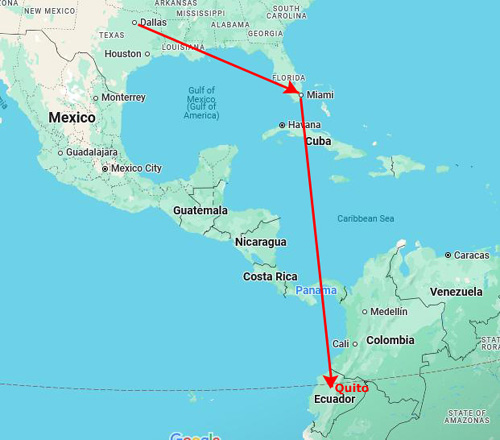
Not only did the routing on Avianca not go anywhere near Miami, the departure time from Dallas was much more civilized. American had changed their schedule such that to make the flight from Miami to Quito, one had to leave absurdly early in the morning for Miami. The Avianca schedule has the traveler departing at 12:45 in the afternoon. The Aviance routing goes almost directly south, making a single stop in San Salvador, the capital of El Salvador, after a three-hour flight from Dallas. The only drawback regarding the flight down is that the layover in San Salvador is a long one- 4+ hours. But if you have something to do or read (like my laptop or tablet or Fred's book) it's not that bad.
The 2.5-hour flight into Quito gets in about 1AM, which means we don't get to the house until about 2, but then that really doesn't matter all that much. The only bad thing about the return routing is when the flight leaves Quito. It is the turnaround of the flight that we take to get here, and so the departure is about 2:30 in the morning. Again, that's not much of a problem. We just take a nap and get up about ten and catch an Uber at midnight to the airport. The layover in San Salvador is a civilized 90 minutes, and we get back to Dallas right about noon. Here is where the Avianca option shines; we clear customs in Dallas, and at that time of day, the customs hall in Dallas is almost empty. (I am getting ahead of myself, but as I will write below, when we actually did return, we spent all of two minutes in customs.)
As far as the perks are concerned, Aviance has three fares. They have a cheap fare for backpackers, and that's about all you can carry- a backpack. No seat selection and you board last. Then there are two "coach" fares, the slightly more expensive of which allows you to select seats. The only seats on Avianca's Airbus planes with decent legroom are in the exit rows, so we chose that fare. At that, the fare is equivalent to American's fare through Miami.
So that is what we are trying this time, and at the end of this page I will be able to tell you how it goes. If it goes well, then this will be our standard routing going forward- shorter flights each leg, same price, some times better, some not so much, and no Miami Airport. We shall see.
|
Anyway, we found Avianca in Terminal D without problem, checked in and checked one bag, and then headed to the gate, arriving there about 90 minutes before the 12:45 departure. Our fare gets us boarding in the second group, but the flight was not overly full, so the boarding was civilized as well.
We found our exit row aisle seats across from each other with no problem. As advertised, there is a lot of legroom in these seats; the other coach seats on our fare are much more cramped. We were the only people in our exit row; why more travelers on our fare don't grab these seats I do not know. The one drawback is that you aren't allowed to keep luggage under the seat in front of you in the exit rows. Apparently, this is true throughout the flight. Whether this is peculiar to Avianca or some more recent IATA change, I'm not sure. I haven't flown on anyone but Avianca since this first trip on them.
No problem, though. We just took out what we needed from our carryons before putting them away. The Aviance planes have seat power outlets, but these are only USB connections. Again, that was OK as I only used my tablet on the flight, rather than trying to use my laptop.
The flight left a few minutes early. I commented to Fred that Aviance must know when all the ticketed passengers have boarded, as otherwise they would need to wait until the actual departure time. The flight to San Salvador was uneventful, and about three hours later we were disembarking in San Salvador.
|
|
On disembarking, we found ourselves in a typical airport concourse. This airport seemed to be quite new, and the concourse we came out into was certainly as modern as any I've been in lately. We followed the signs to the gate where our onward flight would depart, wanting to be at least near the gate even though the flight wouldn't depart for about four hours. On the way down the concourse, we found a wall mural, and decided to use it as the backdrop for a couple of pictures documenting our passing through this new airport and actually a new country for the two of us.
|
Usually, when you just transfer through an airport, you remain in the secure area- as most of you know. But here, for some reason, we had to go through the security screening again. This would not be the last time, either.
After the screening, we followed the signs to the next concourse, and discovered that the San Salvador airport has two wings- one the new one where we arrived, and the other an older, narrower, more congested wing where our onward flight would depart. This wasn't a problem, of course, although there were many more people in this wing making walking down the concourse a bit slower.
It was a fairly long walk, but there was a lot to see. As with most airports these days, the concourses are full of concessions- food, predominantly, but also duty-free, souvenirs, and all sorts of other shops. This, too, make navigating our way down the concourse even a bit slower.
We knew that we would have a long layover, and that our onward flight wouldn't leave until after 9PM. We also knew that when we arrived at the house in Cumbaya, there wouldn't be anyplace open where we could eat. So we opted for stopping at a Burger King near our gate.
After we'd eaten, we went a little way further down the concourse towards our gate. On the way, we passed an area off to the side of the concourse where there was an area that seemed to be a bit like a small art gallery, with paintings and pictures either of El Salvador or by El Salvadoran artists. We didn't spend much time here, since we were hauling luggage. but I took the two pictures that you can see below:
|
|
We eventually got to our gate area and took a couple of seats. There was no one else here, since the flight was not for hours yet, so we just read or talked for a while. About an hour before our flight, there had been maybe six or eight other people sitting in the gate area, and then the gate personnel arrived. As we watched, they set up an x-ray security checkpoint right in the gate area, and only for this gate. Then those of us who where waiting were ushered back out into the concourse to actually re-enter the gate area through this security check.
Again, this was unusual. We were already in a secure area, having passed through security back at the hub, but here we were doing it all over again. The whole ball of wax- just like any security checkpoint at any US or international airport. It was about now that I noticed that every gate had a similar checkpoint, and this seemed very wasteful. Every other airport we've been through (Miami, Dallas, and even Quito) has a single security checkpoint ahead of all the gates. They had that here, too, but now they had another one at every gate. And each one needed the x-ray equipment, the bins for laptops and shoes and stuff, and all the personnel to run it.
This seemed incredibly wasteful and undoubtedly expensive. Why they have chosen to do things this way I have no idea, but I guess they have their reasons. I didn't see a suggesting box around, and my Spanish was far from good enough to ask why it was being done this way, so whe just had to grin and bear it.
Anyway, we eventually boarded the flight on time, found our comfortable aisle seats, and settled in for the three-hour (actually about two and a half hours) flight to Quito. We arrived on time a little after one in the morning. Getting to the house from the airport is routine now, and you'll see the maps below each time we come down here.
|
|
Exiting baggage claim, I just pause to locate an Uber, and one usually picks us up outside within a few minutes. The route into Cumbaya is about twenty miles and usually takes about thirty minutes- less late at night when we arrive. We used to just have the Uber drop us at Paseo San Francisco, but I've gotten good enough with the directions to get the driver to drop us right at the gate to our community- Santa Lucia Baja. This time, I got the gate guard to open the gate and we had the Uber take us right to the gate for our little three-house compound.
We got inside, set up the laptops (I brought the small Samsung for Fred), and as we were a little wired, we had a snack. Along about 2:45 we were getting ready to shut everything off and go to bed. Just as we were finishing up doing this, the power went off. I took out the flashlight to look at the circuit breakers and they all seemed fine. I had no idea what the problem was, but since the power had been on when we arrived, I assumed it was some local thing- and indeed the area around our house was dark. Since were heading off to bed anyway, we decided not to worry about it, hoping that the problem would be resolved in the morning.
A Note About Our Pictures from Ecuador
On this trip to Ecuador, we had not planned any particular outings. We have no guests this time, and we planned on just hanging out and relaxing ahead of what we knew was going to be a hectic election next month. We have Jeffie coming to Fort Lauderdale for the event, which we hope will turn out well.
There are outings we look forward to making here in Ecuador, such as trips to the hot springs at Banos, the old colonial city of Cuenca, and to Cotopaxi, the volcano about thirty miles south of here. When we do take those trips, we will, of course, be taking lots of pictures.
But on this trip, for reasons that became apparent about a week in, we didn't do these things, and so even though we are in what to many of you might seem to be an exotic location, our pictures on this trip were relatively few. In just doing things around the house, going out for walks, or heading out for a meal, we did litle that we hadn't already photographed and described on earlier pages for trips to Ecuador.
So on this page, I am just going to group the pictures that we did take by activity or subject. There won't be all that many.
Santa Lucia Baja
As you probably already know, our gated community ("urbanizacion") is located just south of the Paseo San Francisco Mall east of, and up the hill from, the center of Old Cumbaya.
|
The exit is only clogged at rush hours, as it empties out right onto Avenida Oswaldo Guayasamin, and right where it enters the large traffic circle just northwest of the mall. Because there is a light where the Avenida enters the traffic circle, the traffic on that main street backs up down past the mall, and this would basically keep cars exiting the mall garage from merging onto that street. Because of this, one of the mall's security personnel is usually stationed where the exit enters the avenue, and he stops traffic on the avenue as necessary to allow cars leaving the mall to merge onto it. When we take the walkway you can see in the picture, to go behind where I am standing and up towards the circle, we often have to wait until the traffic on the avenue is stopped at the light and so the traffic leaving the garage is also stopped to go between the cars. But this is usually only around the end of the workday.
We walk through the gate a few times every day. There are gates for cars entering and leaving, of course, but there is also a pedestrian gate right next to the guardhouse, and the guard will open it for us (and other pedestrians) when he sees them coming and recognizes them as residents. We always call out a cheery "Buenos Dias" or "Buenos Tardes" or "Buenos Noches" (depending on the time of day) when we approach the gate, and then a "Gracias" when he unlatches the gate for us.
We are of course very familiar with the walk to the house from the gate; the road through the community is basically a square, with the gate at one corner and the gate to our little three-house compound at the opposite corner. Sometimes we go clockwise around the square, bearing left after the gate, going down the backside of the mall, and then turning right and up a small hill to our own gate. Most times, though, we go counterclockwise, bearing to the right through the gate, going up for a ways to the corner, and then turning left to head down the hill to our own gate. No matter what the time of year, or which way we go, the "eternal spring" weather here in Cumbaya means that we will almost always see some beautiful blooms along the way.
|
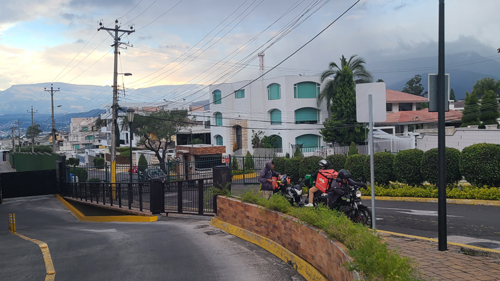
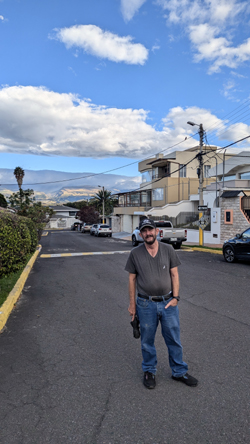
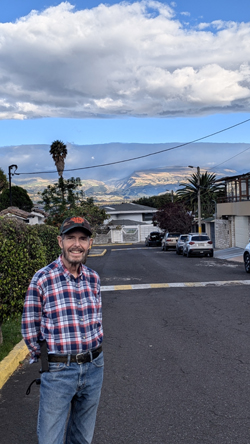
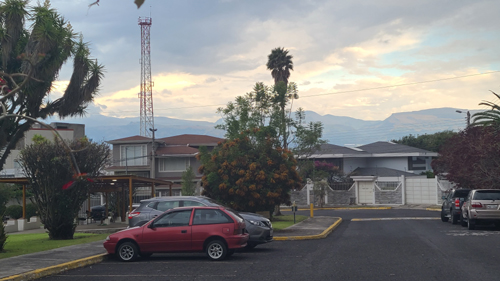
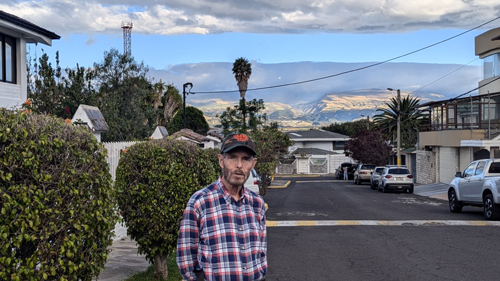
Once we go through the gate and go right up the hill to the next corner, we really can't see much. But when we turn that corner and are looking down the street to the corner where our little compound is located, we have excellent views again. On one particularly nice day, we stopped at this corner and took the two pictures at right. You can see the gates (pedestrian and auto) to our own little compound down the street.
As I said, the one-way street through our community is essentially square. On the west, south, and east sides of the square are the houses that form our community. Behind them, a wall encircles the area. The back side of the mall lies along the north side of the square, and so no houses are there, of course. In the middle area there are houses along the north and west sides; a park occupies the southeast part of this middle area- the same corner as our own little compound. So when we exit our own gate, the park is right in front of us.
These views can be really spectacular on clear days, when the sunlight and clouds cast shadows on the hills in the distance. Incidentally, we can't really see Cotopaxi from here; the best views of it are from up in Quito, because here the hills and trees block it. Sometimes we can see it from the pedestrian overpass on the other side of the mall. Here are two more pictures looking down the street towards our gates:
|
|
Around the House
We've already taken pictures of all the renovations, and if you want to have a complete tour of the house, you can look at one of our earlier trips- notably our trip down here a year ago. So not many pictures around the house this time. One thing we did notice on the second or third day of this trip was the prominent crack in the large window by the upper seating area of the living room. The crack wasn't there last May, and our supposition, confirmed later by our contractor, was that the crack was caused by an earthquake. These are not common here (at least not those you can feel), but there had been a couple since we were here last. In any event, our contractor helped us find a glass company, and they came out and measured the window and had it all fixed before we departed.
So what other pictures did we take around the house this time?
Assembling the Water Filter
|
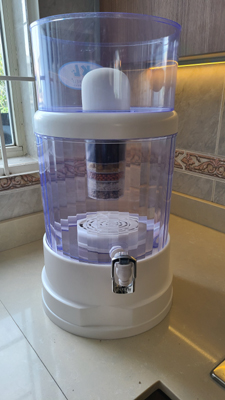
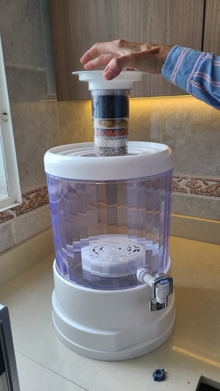
Below this upper reservoir is the larger reservoir that contains the filtered, treated water. Hanging down from the upper reservoir is a seven-stage filter, comprised of layers of filter material, each of which focuses on one or another impurity. I don't know exactly what they all are, but taken together they make the water drinkable and unlikely to cause any digestive problems except in the most sensitive of people. The water filters down through this system very slowly, entering the bottom reservoir at a steady but only moderate drip. Eventually, the water in the lower reservoir touches and then rises above the bottom of this filter, but fluid dynamics being what they are, the filter continues to work until the water in the upper reservoir is exhausted or the bottom reservoir is full.
Finally, there is an optional, but recommended container of minerals that one just places in the bottom reservoir. This restores some of the expected minerals to the water, and also makes it taste more like the water we are all used to. This system works very well, as all you really need purified water for is for drinking (or for the coffeemaker, or whatever). We put bottles of purified water in all the bathrooms. For cooking, tap water usually works (if you are going to be boiling something like pasta).
You can see our unit at left (although we haven't put on the top that keeps dust out of the upper reservoir.
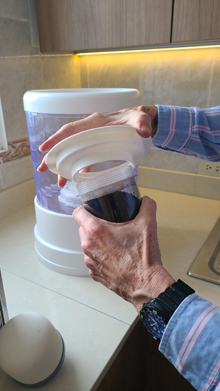
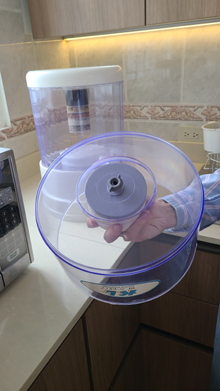
Just because we have them, below are some pictures of the assembly process for this water filter:
|
On the Patio
|
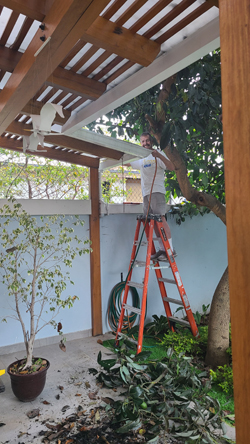
Not so the avocado tree. In this climate, it grows like a weed, and every time we come down here it is noticeably larger. This would also not be a problem, but the tree is in a confined space, and we continually have to prune it back (at least the parts of the tree we can reach).
It has also grown out over the patio cover, and drops leaves on top of the cover. These wash down into the gutter, with the result that the gutter gets a lot of leaves in it. These decay and if we are gone a long time, the decomposed material can clog the downspout.
At left you can see that we have been pruning the tree, and we have a couple of piles of cut up branches that are ready to be bagged and taken out to the street. Those that fall on the artifical turf can either be swept off onto the tile and bagged, or we can just spend a few minutes picking them up.
You can also see that I am up on the ladder cleaning out the gutter. To keep the downspout from clogging, we went to the hardware store and got some mesh that I could put in the bottom of the gutter to let water through but trap any leaf fragments that might be small enough to into the downspout. Cleaning out the gutter is a once-in-each-trip process.
Walking Around Cumbaya
You may recall that we toured a couple of condominiums in the Aquarela complex a couple of blocks northwest of our community before we decided to buy the house we now have. That complex has been expanding in the few years since we visited it. Now, if you go outside the gate of Santa Lucia Baja, and walk southwest down the street a ways, you can get a good view of the Aquarela condominium complex. I think it has reached its full extent, although the new towers are not yet finished.
|
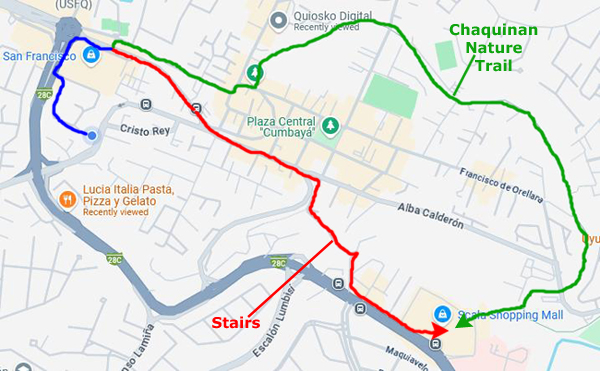
At left I've put a small map showing the route we most often follow (although not my favorite way to go) to get to the old town square (officially known as "Parque Cumbaya"). If you like, you can relate the pictures in this section to the annotated map.
From the house, of course, we have to leave our little compound and walk to the guardhouse for Santa Lucia Baja. We can either turn right around the circle and take Calle 1 to the guardhouse, or head straight and then right around Calle D to get there. Six of one half dozen of the other.
|
A short ways down the side of the mall you can see the overpass that connects the mall to the University of San Francisco of Quito. Fred likes to take this overpass over to the university and then down the ramps next to it to come out on Francisco de Orellana. I actually prefer to just cross Av Maria Angelica Idrovo there at the traffic circle and walk down that street. I like to look at and into the little shops that line most of that street; over on de Orellana there is actually not that much to see. The route I like is a trifle longer, but I think more interesting. But not so much so that I don't usually aquiesce and follow Fred across the overpass.
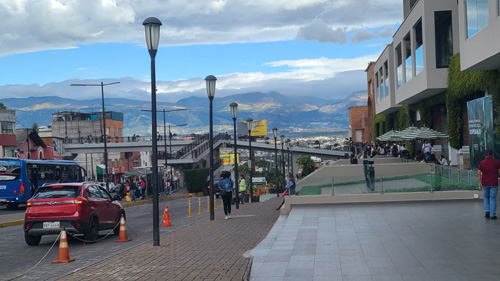
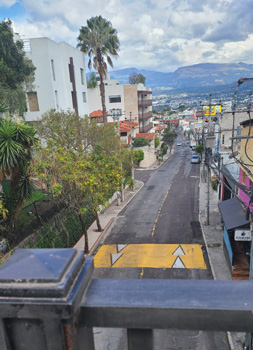
The nice thing about taking the overpass, particularly during the daytime, is that the views east and down across the Tumbaco Valley are pretty neat. There are also good view up the mountainside to the northwest towards Quito, and you have seen pictures of both of those views on the pages for earlier trips to Ecuador. Today, I just took a couple of pictures from the north side of the overpass:
|
|
On the north side of Orellana, the overpass has three sloped flights of ramps. Descend two of them and you are at the entrance to the University grounds- an entrance used only by students who show their IDs. One more ramp descends to the north side of Orellana.
|
Fred likes this route as there is less traffic- fewer people and fewer cars and no buses. But it lacks a lot of activity, and that makes it a more secluded and quiet walk down the hill.
You can see the route we take on the map above. On Orellana we pass a small Mormon church (go figure) and a fairly large nursery operation that we've visited a few times. There are also a few gated communities on the north side of the street. At the bottom of the hill, if you jog to the right, you'll come to Rey Pan (King Bakery) which is Fred's favorite in the area. As you can see on the map, you can get to the square by either turning right or left at the bottom of the hill. If you turn right, you'll curve around the Hotel Cumbaya and take Garcia Moreno down to the square. Turn left, and then right and you will continue on Francisco de Orellana to the square.
Along the Garcia Moreno, there's Ali's Restaurant opposite Hotel Cumbaya, that has decent pizza and an extensive menu, and a bit further down the street my own favorite bakery- Panificadora El Reventadito. Also along this street on the way to the square are numerous restaurants, including Pizzo Tres, Pizza Planet, and Viva Zapata. There is also an authentic Ecuadorian ice cream shop, with ice cream made the traditional way in a huge copper bowl rotated rapidly across salted ice. It is usually very busy.
Along the other street, Orellana, there are also numerous restaurants, including a good Italian cafe, a great (and very reasonable) steakhouse, and Cassolette- a restaurant with a varied menu that we tried for the first time on this trip. (We happened to take pictures of each other when we visited, and you can see those pictures here and here.
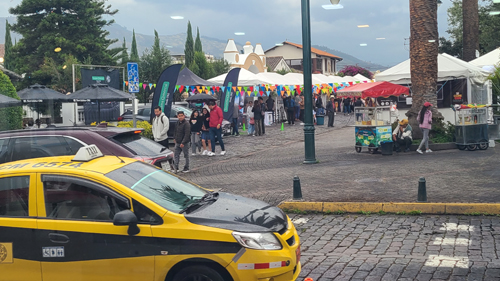
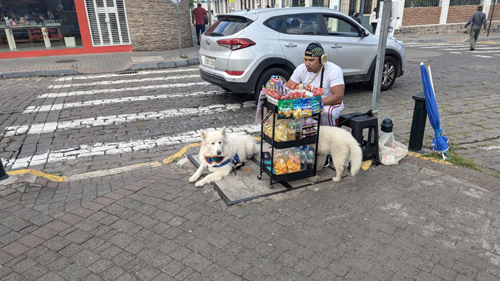
At the square, we often just sit by the fountain and people-watch. This is always a pleasant activity- as long as it isn't raining. There is often a lot going on around the square. On weekends, there is a kind of "fair" along the east side of the square, where vendors set up little booths and sell everything from honey to crafts to clothing to foodstuffs. And there are almost always lots of individual vendors who set up shop all around the square.
|
|
There are also lots of restaurants all around the square, some of which we've tried. There is also a church on the east side and the gallery from which we've bought our artworks- Marsu Arte- is on the northeast corner. The walk down here and back is always pleasant- although a bit more strenuous going back up the hill!
Walking Down to Scala Mall
One of the walks we take frequently is from the house down to Scala Mall- a busier mall with more stores that is a little over a mile down the hill from where we are.
|
It is used by hikers, walkers, and bikers, and we consider it a jewel of the area. You can see the route to Scala Mall via this trail if you look at the map at left and follow the green line. Of course we have to leave Santa Lucia Baja and go around Paseo San Francisco, but then we take the overpass over to Orellana, go down towards the center of old Quito, and follow Orellana until we get to the entry to the trail. Then we follow the trail itself downhill via a wide arc that goes north and then southeast for about Scala Mall. The total walk is close to 3.5km.
On this trip, though, I wanted to investigate what looked on the map to be a shorter route; but the map was a little unclear as to whether this shorter route was actually a through street. So we experimented. This route (shown in red on the map) eschews the overpass to continue down Maria Idrova. Just past the intersection where this major street curves around and down the hill, there is a residential street on which we turn right. It turns out that this street is gated for cars but open for pedestrians and leads to four or five nice homes. But the street ended and we thought it might not go through. But where it ends, it turns into just a walkway/staircase that slopes steeply down the hillside. This part of the route can only be made on foot. Towards the bottom of the hill the walkway comes out onto another actual street. This street comes up the hill off Oswaldo Guayasamin; again, it leads to some residential areas. We can now follow this street down the hill and across a bridge and then up to Oswaldo Guayasamin itself. Then we can turn left and walk the level three blocks to Scala Mall.
This route to Scala Mall is much shorter than taking the trail, and going down the hill it is not bad. But the walkway is very steep, and would be a challenge coming back up. So when we walk down to the mall, we've begun to take this route down but return along the trail. The trail is longer, but is a comparatively gentle upward slope.
|
|
|
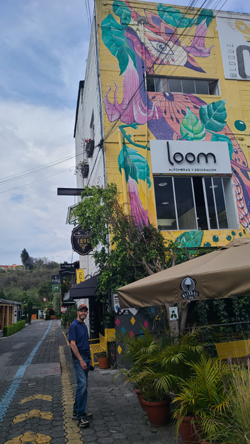
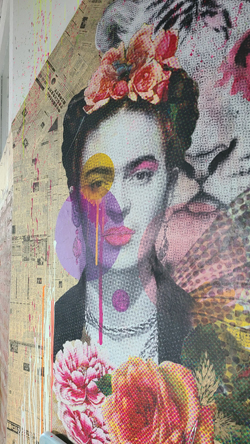
Fred took a couple of pictures here. The picture at the far left shows the building where their offices are located. There are other firms and shops- all with a creative bent- located in this building. The picture at the near left is a mural on the side of another building in the complex, and the woman depicted should be familiar to you.
Walking back up the Chaquinan Nature Trail is always enjoyable. Not only is the upward slope gentle enough so as not to be strenuous, but there is lots to see along the way= from exhibits and murals along the trail to views of houses in neighborhoods north of the trail and on the other side of a deep ravine.
|
|
The Sakura Building
I mentioned above that during this stay in Ecuador, the country was having power problems due to lack of rainfall in the area of the country where most of the hydroelectric power stations are. We adjusted to them; the outages were published online so you could plan ahead. We knew that many apartment buildings had their own generators; our contractor lives in such a building. On a lark, we thought we would see what a typical apartment in one such building was like.
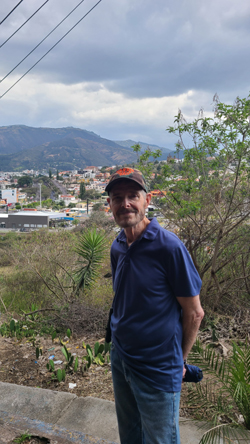
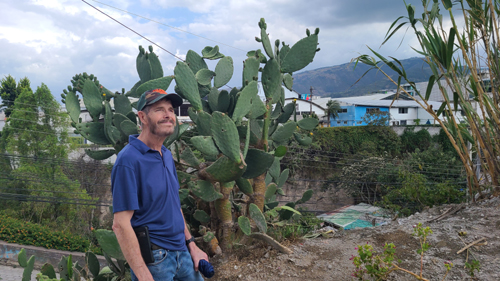
The building we chose was called Sakura, and was located near USFQ over on Orellana. We walk by the building frequently on our way down to Old Cumbaya, and I'd noticed that there was a "For Sale" sign in front of the building. I texted the number given and a few days later we met the Realtor who gave us a tour of the building and of the condo that was for sale. We weren't serious about moving, but were really just curious what highrise living was like around here.
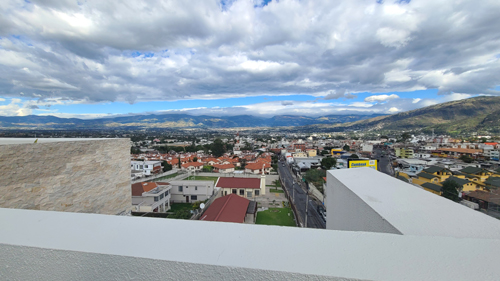
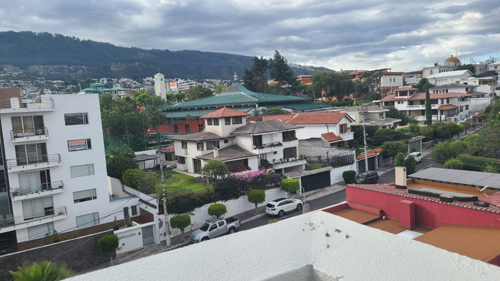
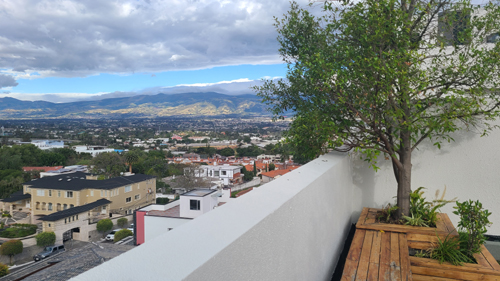
The condo itself was very ordinary. Unfortunately, it was on the ground floor of the building, and really had no views to speak of. It did have a small outdoor area, but this was in an open atrium in the center of the building, and so there were no views there, either. In fact, the only nice thing about the building (other than the fact that it had a generator system) was the rooftop common area. From there the views were pretty great and Fred took a number of good pictures:
|
|
|
|
The Trip Home
We were scheduled to head home on October 23rd, but we ended up going home five days early.
|
Probably the only bad thing about our Avianca itinerary is that the return flight leaves at about 3AM. This basically means that on the day of our return we wouldn't get any sleep- unless it was on the airplane itself. At 1AM were were in front of Paseo San Francisco getting into our Uber for the 25-minute trip to the airport.
We arrived and checked in with plenty of time to spare, and an hour before departure were walking down the concourse to our gate. As with many modern airports, it can be hard to believe you are in an airport as opposed to a shopping mall, the giveaway being the signs directing you through the shops to the actual gate.
We arrived in San Salvador about five-thirty, and at seven-fifteen were boarding our flight to Dallas. We arrived in Dallas before eleven, and walked through the corridors of Terminal D, following the signs for Immigration/Customs. We came out into the large customs hall and were very pleased to find that there was literally no wait at all to speak to an agent at Border Control. Getting through Customs took all of 90 seconds, and consisted mostly of having a picture taken.
This was, of course, exactly why we'd chosen to eschew American Airlines and flying through Miami; coming back we would have had to clear Customs there, and Miami Customs is a literal zoo. By eleven we were getting into our Uber for the ride home.
We will certainly fly Avianca again next February when we return next to Ecuador.
You can use the links below to continue to another photo album page.
|
October 26 - November 17, 2024: Our Fall Trip to Florida |
|
September 6-9, 2024: San Antonio Birthdays |
|
Return to the Index for 2024 |