|
Valuing Your Hand |
|
Introduction to Bridge |
|
Index of Lessons |
Each and every hand in Bridge is played the same way; that is, it has the same "phases." First, the cards are dealt. Second, there is an auction to see which team, if any, will win the "contract". Next, the hand is played to determine whether or not the contract-winning team can fulfill that contract. Finally, the hand is scored.
Phase 1: The Deal
It is efficient to play Bridge with two decks of cards, and at the beginning of play, both are shuffled thoroughly. One shuffled deck is given to the Dealer, who deals the cards out. The other shuffled deck is placed in the corner of the table to the right of the Dealer's opposite team member. Subsequently, the partner of the Dealer shuffles the other deck (the one used in the preceding hand) and places it to his right when he is done.
It is not necessary to keep track of who is next to deal, if a couple of simple rules are followed. If a hand is completed, and you are wondering whose turn it is to deal, simply look to your left. If you see a deck of shuffled cards sitting there, it is your turn to deal. Take those cards and place them between you and your right-hand opponent. He will cut the cards toward you. Place the portion of the deck furthest from you on top of the portion closest to you and deal out all the cards, beginning with your left-hand opponent and moving clockwise around the table, one card at a time.
If it is not your turn to deal, but your partner is dealing, take the cards from the previous hand, shuffle them, and place them to your right. If it it not your turn to deal, and your partner is not dealing, you may relax and do nothing.
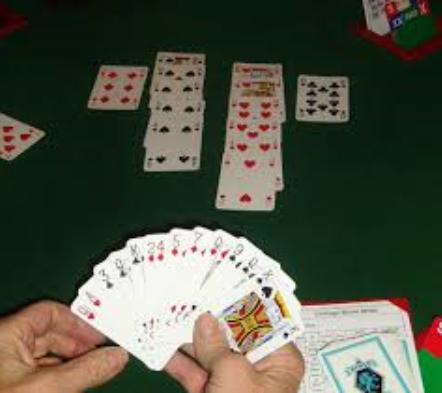
When the dealing has been completed, each player should pick up his cards and arrange them. You are not allowed to show your cards to your partner, and it is a breach of etiquette to allow either of your opponents to see them. (There is no law against that, but it is never to your advantage to do so.) You may arrange your cards however you wish, but you should definitely divide them into suits, alternating colors so you do not inadvertently mix red suits and black ones. Within each suit, it is best for beginners to put the cards in order by rank, left to right or right to left.
 |
Since there are 52 cards in the deck, and since there are four players, when all the cards are dealt out, each player should have 13. Mistakes happen, however, and so each player should count his cards before looking at them. If everyone has 13, then each person can go ahead an arrange his cards. If anyone has fewer or more than 13, then a "misdeal" has occurred. The cards should be reshuffled and redealt (after someone first checks to make sure that the deck is not short a card or two!). |
Phase 2: The Bidding
| Definition: A Call A call is either (1) a statement by a player that consists of a number from 1 through 7 along with either the name of one of the four suits or the word "Notrump", (2) the word "Pass", (3) the word "Double" or (4) the word "Redouble". (NOTE: Most players distinguish the first alternative from the others by calling it a "bid", and we will follow that convention here. So we may say that when it is your turn to call, you may either bid or make a non-bid call- "Pass", "Double" or "Redouble".) (NOTE: We will postpone consideration of the two calls "Double" and "Redouble" until later. For now, when it is your turn to call, you may either bid or Pass.) |
The obligation to call continues from the Dealer clockwise around the table. The first person to make an actual bid (not simply "Pass") is referred to as the Opener. Once the auction is opened, then anyone making a bid must ensure that it is higher in number than the last bid made OR names a suit that is higher in rank than the last suit named.
|
Remember that the suits are ranked, in ascending order, Clubs, Diamonds, Hearts and Spades. Although it is not technically a suit, Notrump (the specific declaration that there will be no trump suit) ranks highest of all. |
For example, if the Opener bids 1  , then the next bidder may not bid either 1
  or 1
or 1  . That bidder may, however, bid 1
  or 1
or 1  , or make any bid at the 2-level or higher.
 |
The person on my right has just opened the bidding with 1 (suggesting to his partner that Spades be the trump suit). I would like to suggest to my own partner that Hearts should be the trump suit. Can I just bid 1 ?
Answer: No. Since the Heart suit is lower ranking than the Spade suit, you may not bid it at the one level. You may, however, bid 2 |
The auction continues clockwise around the table. It does not end until three consecutive players have called "Pass".
|
If you call "Pass" at any point, you are simply declining to bid for that round only. If you have another opportunity to bid, you may always do so. For example, suppose that the player on your right opens the bidding with 1 and you Pass. The player on your left bids 2 . Your partner passes and your right-hand opponent passes. You may bid if you wish, remembering that your bid must be 2 or higher. |
|
The rule that an auction ends when there have been three consecutive passes only applies if someone actually makes a bid. Let us suppose that the Dealer, who is to your left, and the next two players all pass, and it is your turn. Even though there have been three consecutive passes, no one has yet made a bid. You may do so if you wish. If you do not, then the hands are thrown in and the deal rotates normally. |
When the bidding ends, the last bid becomes the "contract".
| Definition: Contract A contract is a statement by one of the partnerships as to how many tricks they promise to take during the play of the hand, and which of the four suits, if any, will be considered the "trump" suit. |
For example, let us assume that the bidding proceeded as follows:
|
The last bid in this auction was 4 , and so this becomes the contract. The East-West partnership has committed to taking 10 of the 13 available tricks during the play of the hand. (To determine how many tricks a contract involves, add 6 to the number specified in the contract bid. In this case, it is 6 + 4 or 10 tricks.) So it is important to remember that if you bid at the 1-level and win the auction, you are committing to taking 7 tricks, not just 1. |
The suit that is named in the final contract is called the "trump" suit. If the final contract is in Notrump, then there will be no trump suit.
Phase 3: The Play
The first thing to do during the play is to determine who will be the "Declarer."
| Definition: The Declarer The Declarer is the player on the team that won the final contract who first bid the suit named in that contract. If the final contract is in Notrump, then the Declarer is the member of the contract-winning team who first bid in Notrump. |
For example, let's look back at the last auction:
|
In this auction, we can see that East-West "won" the auction, since they bid higher than their opponents. The final contract was, of course, 4 . But both East and West bid Hearts at some point; which one will be the Declarer?
If you look at the auction, you will see that of East and West, East was the first to bid Hearts when he opened the bidding with 1 |
Once we know who the Declarer is, the play can begin.
|
In the image at right, if we assume that we are East, looking at our own hand, we can see that South has led a heart and our partner has laid down his cards on the table. Note how they have been laid down. The suits have been separated and the cards laid down in order of rank within each suit, with the highest-ranking card at the "top". The next-ranking card has been laid on top of it and somewhat down so the Declarer (and everyone else) can see all the cards. In this hand, West seems to have had 1 Diamond, 5 Spades, 6 Hearts and a single Club.
By convention, the trump suit should be the leftmost stack- as viewed by the Declarer. If this were the hand from the auction we just looked at, then we should ask West to switch the Hearts and Diamonds so that the trumps would be on the left. It is also a good idea to alternate the suits so the two red or two black suits are not laid down next to each other.
Why does the Declarer's partner lay his hand down? It is so the Declarer can play the entire hand for his team, which is just the way Bridge works. Since the onus is on the Declarer to "make" his contract, we give him the advantage of seeing all his team's cards. His opponents, who are under rather less pressure, do not get to see each other's hands. But then this means that the opponents get to see half of your team's cards, so I guess things balance out.
After Declarer's partner lays down his hand, he has nothing else to do during this particular deal. In fact, he should not say anything to his partner, or help him in any way. It would be good time for him to go get coffee. It is for all of these reasons that the Declarer's partner is referred to as "the Dummy".
Once the person on Declarer's left has laid down his first card (made the "opening lead") then Declarer will select a card from his partner's hand (the "board") to play and put it in the center of the table. Then the other opponent will play and finally Declarer will play a card from his own hand (which is not visible to the opponents). The first trick will be complete.
In case you haven't played a trick-based card game before, we should talk a bit about what tricks are.
Tricks and the Concept of "Trump"
|
| Definition: Trick A trick is a group of four cards, one from each player. Tricks are created during the play of the hand. Since each player has 13 cards, there will be 13 tricks in each hand. |
This graphic merely illustrates that the cards are played to the center of the table because, as you saw above, Declarer's partner should already have laid down his hand. Anyway, although we cannot know for sure who "led" to the trick (who was the first player to put a card in the center), we can see that the North hand played the King of clubs, the East hand played the four of clubs, the South hand played the five of clubs and the West hand played the six of clubs.
One ironclad rule of the game is that during the play of the hand, when it is your turn to contribute a card to a trick, and you are not the first person to play to the trick (the "leader"), then you must "follow suit". That is, you must play a card from the same suit as the card that was led to the trick originally. In the image at right, if we assume that South led the five of clubs to the trick, then West was obliged to play a card from that suit (although he is free to play any card he wishes from that suit). The same rule applies to all three of the players after the original lead.
If you do not possess a card of the same suit that was lead to the trick, then you may play any card from your hand.
Determining the Winner of a Trick
The only time this rule does not apply is if one of the four players has contributed a card that happens to be from the trump suit.
| Definition: Trump Suit The suit named in the final contract. For this hand, the trump suit will outrank all others- regardless of the natural ranking of the suits. Any suit may be named as being the trump suit for a given hand. It is also possible to specifically declare that for a given hand there will be no trump suit. |
So, we must modify our rule for determining who has won a given trick. The winner of the trick is actually the person who contributed the highest-ranking card of the suit led unless one or more players have contributed a card from the trump suit (if any). In that case, the player who contributed the highest-ranking trump suit card is deemed to have won the trick.
For example, let us assume that during the bidding, Hearts was named as the trump suit. During the play, South led the Ace of Clubs to a particular trick. West, having no clubs in his hand, chose to play the 2 of Hearts (a card from the trump suit). (In Bridge "lingo", West is said to have "trumped".) North did not have any clubs either, and so he played the 4 of Hearts. (In Bridge lingo, North "overtrumped".) East did have a Club, and so he played the 8 of Clubs. Since there was at least one card from the trump suit played to the trick, whoever played he highest card from the trump suit won the trick- North in this case.
|
During the bidding, Spades is named as the trump suit. During the play, West leads the J. North plays the Q, East plays the 6 and South the A. Who won the trick? Answer: East did. Although North played the highest-ranking card of the suit led, and South played the highest ranking card, East played a trump, and since it was the highest-ranking trump played, he won the trick. |
What Happens to the Tricks?
|
The piles should be kept in such a way so that it is easy to determine, at the completion of play, how many tricks each team has won. Here, you can see that each trick has been placed at right angles to the previous one and overlapping. It is easy to see that this team has won six tricks. (It is also easy, if it becomes necessary, to go back to a particular trick and see which cards have been contributed to it.)
NOTE:
Unless there is a question as to whether a particular player had played properly to a past trick, it is not allowed for a player to look back at previous tricks during the play of a hand. It is allowed, however, for a player to request to see the last trick, after it has been turned face down in front of the winning player, so long as no one has led to the next trick.
The Second and Subsequent Tricks
Phase 4: Scoring
There are significant bonuses for bidding games and slams. You will learn later that the games are 3 , 4 and 4 , and 5 and 5 . The slams are contracts of 6 or 7 in any suit or Notrump.
When you think that bidding and then making any of those games is a reasonable proposition, you should make every effort to do so. If you think that bidding and making a slam is possible, you should at least investigate it.
A corollary is that if you come to realize that making a game is NOT "in the cards", you should stop bidding at the lowest level possible.
Finally, the way the scoring is done, making the same number of tricks in Notrump is worth more than making them in Hearts or Spades, and making them in Hearts or Spades is worth more than making them in Clubs or Diamonds. So when you have the option (and often you don't), opt for contracts in Notrump over Hearts and Spades, or Hearts and Spades over Clubs and Diamonds.
In a later lesson, we can talk more about scoring.
|
Valuing Your Hand |
|
Introduction to Bridge |
|
Index of Lessons |