August 16-20, 2021: A Trip to Santa Fe
July 10, 2021: An Evening at the Theatre
Return to the Index for 2021

July 23, 2021
"Buddha Shiva Lotus Dragon"
The Rockefeller Asia Collection at the Kimbell


Meeting the Girls in Fort Worth

This Thursday and Friday, Prudence and Nancy have come up to Fort Worth for a meeting, and, as they so graciously often do, they asked us to join them on Thursday evening for dinner and Friday afternoon and evening for a visit to the Rockefeller Asia Collection exhibit at the Kimbell Museum and then some supper. We are always happy to see them whenever we can, so we first joined them at the Kimpton-Harper Hotel in downtown Fort Worth for some wine and supper.


Prudence used to stay at the Worthington, but since she likes to bring Jax with her, she found the Kimpton-Harper hotel just a few blocks south that is pet-friendly. There is also a park a block down the street where she can walk with Jax.

Add that to the fact that the restaurants she favors are all close by (the Capital Grille is right across 7th Street from the Hotel, and the Cheesecake Factor and Ruth's Chris are just blocks away) and the hotel is a good choice for her and Nancy.

The hotel front desk and bar are on the 24th floor of the old building, so that's where we usually meet them. Being high up, there are usually good photographs to be had.


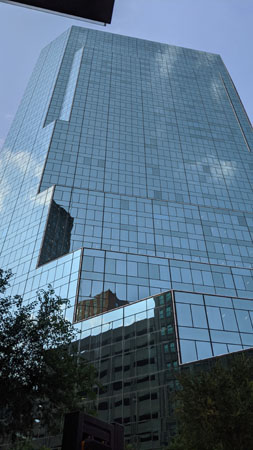
Just across the street from the Kimpton Harper is a modernistic glass tower called "777 North Main"; it is your typical office tower housing a great many tenants, including a number of oil companies as well as the technology arm of the H‑E‑B Grocery chain. The photo at left was taken just outside the Kimpton.


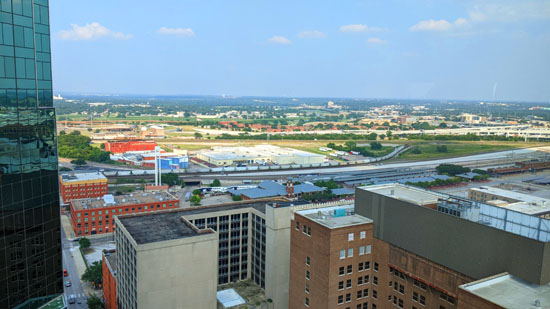
The views are even better from upstairs at the front desk, and while we were waiting for Prudence and Nancy to come up from their room, I took the picture at right that looks southeast (past the edge of 777 North Main).

We had a nice dinner with the girls at the Capital Grille, and we returned to Fort Worth again the next day so we could meet up with them after their meetings to head over to the Kimbell Museum for the exhibit.


The Kimbell Art Museum

We have been to the Kimbell so many times that I am sure you have seen at least one page devoted to a visit we made there- most of them to special exhibits such as the one today.


The Kimbell Art Museum in Fort Worth, Texas, hosts an art collection as well as traveling art exhibitions, educational programs and an extensive research library. Its initial artwork came from the private collection of Kay and Velma Kimbell, who also provided funds for a new building to house it.

The original building was designed by architect Louis I. Kahn and is widely recognized as one of the most significant works of architecture of recent times. It is especially noted for the wash of silvery natural light across its vaulted gallery ceilings.

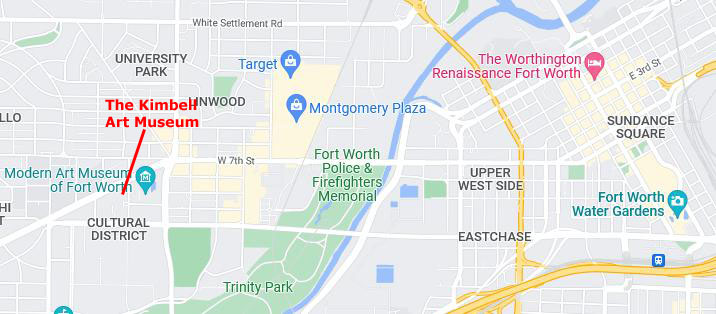
The Kimbell is one of four museums and other attractions in Fort Worth's "cultural district". Nearby are the Fort Worth Museum of Modern Art, the Amon Carter Museum of American Art, and the Fort Worth Science Museum.

Kay Kimbell was a wealthy Fort Worth businessman who built an empire of over 70 companies in a variety of industries. He married Velma Fuller, who kindled his interest in art collecting by taking him to an art show in Fort Worth in 1931, where he bought a British painting. They set up the Kimbell Art Foundation in 1935 to establish an art institute, and by the time of his death in 1964, the couple had amassed what was considered to be the best selection of old masters in the Southwest. Kay left much of his estate to the Kimbell Art Foundation, and Velma bequeathed her share of the estate to the foundation as well, with the key directive to "build a museum of the first class."

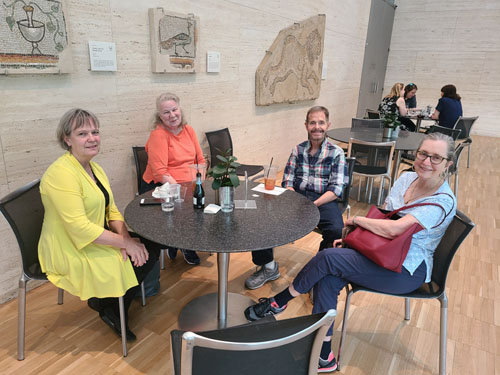
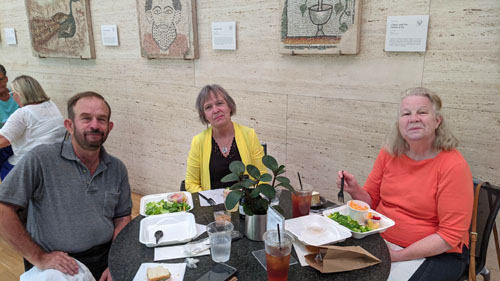
Fred, Prudence, and Nancy at Lunch in the Kimbell

The Foundation's board of trustees hired Richard Fargo Brown, then director of the Los Angeles County Museum of Art, as the founding director of the museum, and it was he who thought the building should be "as much a gem as one of the Rembrandts or Van Dycks housed within it." The proposed museum was given space in a 9.5 acre site in Fort Worth's Cultural District. After interviewing a number of prominent architects, the museum hired Louis I. Kahn in October 1966. Construction began in the summer of 1969; the new building opened in October 1972 and quickly achieved an international reputation for architectural excellence.

On Brown's death in 1979, Edmund Pillsbury continued the disciplined expansion of the Kimbell collection, and a decade later it became obvious that more space would be needed. Pillsbury originally thought to expand the existing building, but there was strong opposition to any major alteration of the original Louis Kahn structure. In 2007, the Kimbell solved that problem by announcing plans to construct an additional, separate building on the lawn west of the original building. Designed by Renzo Piano, the new structure opened to the public in November 2013.

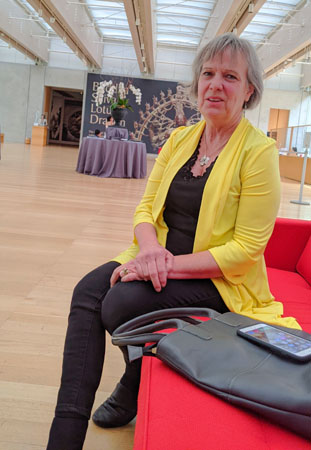
Here are two more pictures we took while we were having lunch in the Kimbell's little restaurant:
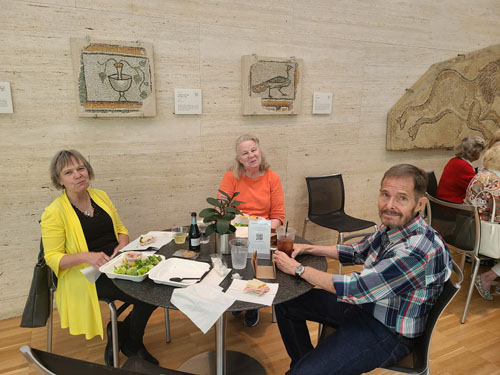
 

On other pages, I have talked a bit about the Kimbell's permanent collection. Founding Director Brown set the tone for the collection by including this directive in his Policy Statement: "The goal shall be definitive excellence, not size of collection." Accordingly, the museum's collection today consists of only about 350 works of art, but they are of notably high quality. The museum owns only a few pieces created after the mid-20th century (believing that era to be the province of its neighbor, the Modern Art Museum of Fort Worth) and no American art (believing that to be the province of its other neighbor, the Amon Carter Museum).

Entering the Piano Pavilion
(Mouseover Image if Video Controls Not Visible)

It is the new Renzo Piano Pavilion where most of the temporary exibits are housed; the building was specifically design to accommodate them. Most visitors, such as ourselves, get to the pavilion by simply exiting the Kahn building (where we had lunch) and walking across the lawn and courtyard to the new one.

I made a movie as we were walking across from the Khan Building, and you can use the movie player at left to watch.

Beginning in 2006, expansion was again being discussed, but this time Director Timothy Potts and other officials of the Foundation were assuming a new building would be the best option, an idea exactly in line with Louis Kahn's own thoughts for expansion. At that time, the new structure was to be sited on land to the back of the Kahn building. In April 2007, the museum announced that Kahn associate Renzo Piano (The Art Institute of Chicago, the Nasher Sculpture Center in Dallas, the Pompidou Centre in Paris) was chosen to design the new building.

The 85,000 square foot structure would complement the original building but not mimic it. Unlike the original, its lines would be rectilinear, not curvilinear. Like the original, however, it would have three bays with the middle bay stepped back from the other two. The new Renzo Piano Pavilion was officially inaugurated to the public on November 27, 2013.

Prudence in the Piano Pavilion

The movie above takes you into the area of the pavilion that lies between the exhibition space to your left, and the gift shop to the right. Here one finds the admission desk for the exhibits, a membership kiosk, and facilities. In the middle of the building are atriums with tables and chairs. At the "back" of the building a two-level structure housing offices, classrooms, an exhibition space for the Kimbell's own collection of sculpture, and an auditorium. I made another movie in this section of the building, and you can use the movie player below to watch it.

In the Piano Pavilion
(Mouseover Image if Video Controls Not Visible)

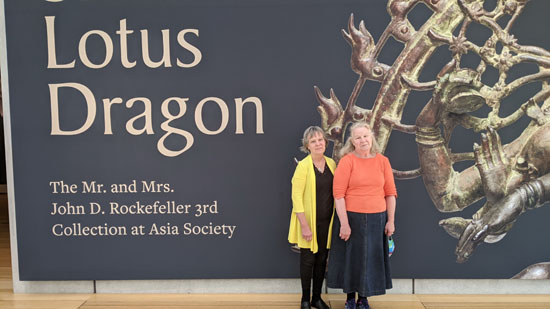
Prudence still has a membership to the Kimbell, so that took care of our admission to the exhibit, but Fred and I got audioguides for everyone; we have found these to be a good investment over the years. Then we had an obliging docent take a couple of pictures of us outside the exhibit:
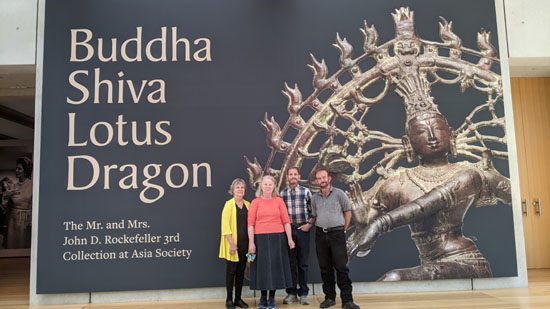


A Walk Through "Buddha Shiva Lotus Dragon"

Now for the main reason for this album page- a walk through the exhibit of John D. Rockefeller's collection of Asian art from the Asia Society Museum. I photographed my way through the exhibit, listening to the audio guide, admiring each piece, and then photographing it and its explanatory plaque. The exhibit was divided into some loose groups of items, and by and large the audio tour took me though one group at a time. There was not an audio entry for each item, but more than half of them.

So how best to take you through the exhibit? I think the best way is to simply show you a picture of each piece, let you read it accompanying plaque, and, if there was an audio entry for it, let you listen to that entry.


For the audioguide entries, I have put little audio players (like the one at left) either beside or below the 15 artworks that were "stops" on the audioguide tour. To listen to the audioguide, all you have to do is click "Play" on the little audio player. When you do that, I think you should immediately click on the artwork itself to enlarge it so that you will be better able to see the elements that the art experts talk about. A few audioguide "stops" talked about more than one of the artworks. When they did, I have put those artworks together, and if the experts happen to move from explaining one artwork to explaining another, you can just close the enlargement window for the first work and enlarge the other. This will not interrupt the audio.

We will travel through the exhibit seriatim, from the opening description of the collection through the various groupings of the items in it.
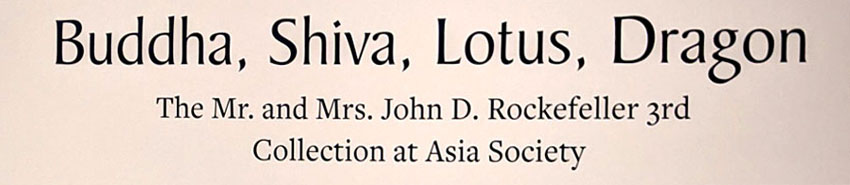
 

History of the Collection/Background of the Exhibit

John D. Rockefeller 3rd (1906-1978), the founder of Asia Society, bequeathed to the institution a collection of nearly three hundred works of art, which he had assembled with his wife, Blanchette Hooker Rockefeller (1909-1992), in the decades after World War II. Their collecting was intended for more than personal gratification; they believed that direct encounters with astonishing art could improve cross-cultural understanding between citizens of the United States and those of Asia, positively influencing international relations.

(Play Audioguide)

Through the lens of nearly seventy works from that foundational gift, "Buddha, Shiva, Lotus, Dragon" iNuminates the impact and transformation of artistic styles associated with Buddhism and Hinduism as these belief systems were transmitted from their birthplace in India across the continent over hundreds of years. Likewise, ceramics and metalwork from China, Japan, Korea, Vietnam, and Thailand— intended to sustain life both in this world and the next—reveal complex networks of artistic exchange through trade, missionary activity, and political and social change. This presentation of the great artistic achievements of Asia’s diverse cultures continues the Rockefellers’ vision of sharing extraordinary works of art with audiences in the United States.


John D. Rockefeller 3rd, Sherman E. Lee, and the Building of a Collection

John D. Rockefeller 3rd grew up surrounded by the collection of Asian art that his parents, Abby Aldrich and John D. Rockefeller Jr., had acquired. As an adult, his tastes and interests in Asian art were further expanded as a result of his life experiences. After his service in World War II, he became involved in the international politics of Asia, working for the 1951 peace mission to Japan led by John Foster Dulles. Rockefeller later established the Council on Economic and Cultural Affairs, Inc. (CECA), an organization created to stimulate and support international economic and related activities with a focus on Asia.

(Play Audioguide)

In the decades after the war, Rockefeller traveled extensively in Asia and developed strong friendships throughout the region. Alongside Blanchette, he began acquiring the finest examples of Asian art, working with the renowned specialist in Asian art and director of the Cleveland Museum of Art Sherman E, Lee (1918-2008) as an advisor between 1963 and 1978. Together, they created a collection of the highest possible quality, with a specific emphasis on the three-dimensional works that "stirred and lifted" them.

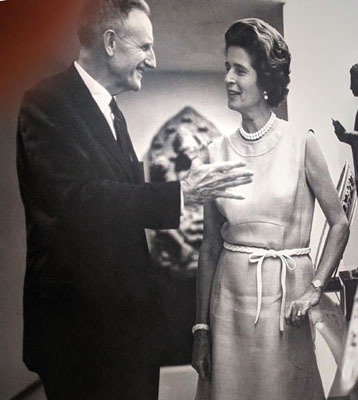
John D. Rockefeller 3rd and Blanchette Hooker Rockefeller viewing a display of some of their collection in the reception area of Mr. Rockefeller's office at Rockefeller Place, New York, c. 1968. (Rockefeller Archive Center)
 
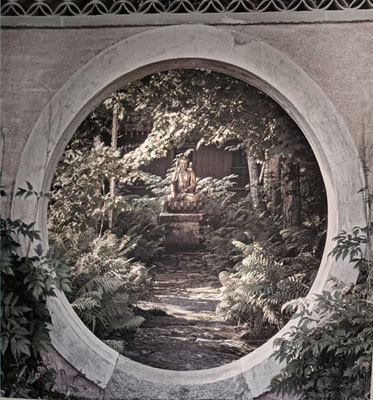
Circular doorway looking toward the Buddha Shakyamuni in the Abby Aldrich Rockefeller Garden, Mount Desert Island, Maine, 1960.


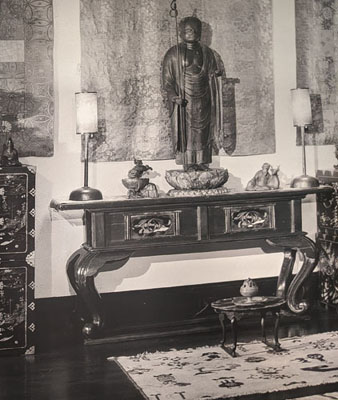
At left is an interior view of the Buddha Room at the Eyrie, the Rockefeller home in Mount Desert Island, Maine, in 1960.

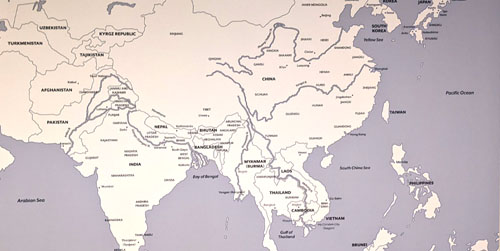
Below is a map of the areas through which the Rockefellers traveled in the acquisition of most of the items in the collection.

With those introductions made, we can begin to work our way through the exhibit. As I said earlier, I'll be showing you each of the pieces in the collection, in the order they appeared. Be sure to listen to the Audioguide entries when they appear, as they provide an in-depth explanation of what you might be seeing at the moment.


The Buddha

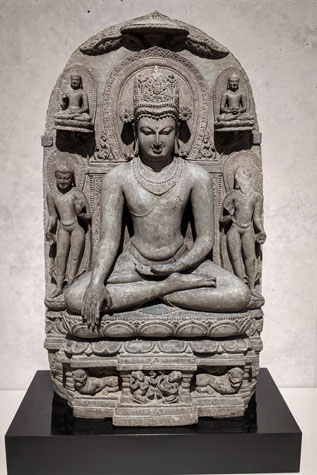
The historical Buddha Shakyamuni (Sage of the Shakyas) was born a prince named Siddhartha Gautama during the fifth century BC, in a kingdom on what is now the border of India and Nepal. Profoundly troubled by his encounters with sickness, aging, and death, he rejected his princely life to embark on a spiritual journey. After years of extreme self-discipline did not reveal a way to end the pain of existence, he sat under a tree to meditate and achieved enlightenment, becoming the Buddha, or "Awakened One." After his enlightenment, the Buddha traveled and preached throughout northeastern India, converting many to the Middle Path, which rejected the extremes of both luxury and asceticism in pursuit of nirvana, release from the endless cycle of rebirth.


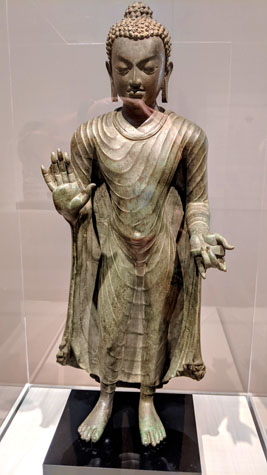
Buddha
India, probably Bihar | Gupta period, late 6th century | Copper alloy
Asia Society, New York | Mr. and Mrs. John D. Rockefeller 3rd Collection | 1979.8

The iconic style of the Gupta period is present in the sensuous full lips, heavy lidded eyes, and oval face of this Buddha. The body, hands, and feet are modeled with a pleasing fullness, and the clinging robe emphasizes the perfection of the Buddha's physical form. These sculptural conventions originated in Sarnath, where the historical Buddha gave his first sermon, and became the prototype for the Gupta style, which influenced regional sculpture in South Asia beyond the sixth century and had an impact on art as it spread throughout Buddhist Asia.

The Buddha raises his right hand in the gesture of reassurance (abhayanudra). His webbed fingers, snail-shell curls, and the bump on top of his head are among the thirty-two lakshanas (auspicious marks) described in Buddhist literature that signify the Buddha’s advanced spiritual enlightenment.

(Play Audioguide)

In the centuries after the Buddha’s death at about the age of eighty, his teachings, or dharma, spread throughout Asia. As the faith encountered new cultures, it evolved into different practice traditions and expanded to include celestial buddhas, savior bodhisattvas, and a wide array of teachers and protectors. Despite these differences, all shared the same goal— to overcome suffering and to end the cycle of rebirth. By the seventh century, Buddhism was a major religious force across South, East, and Southeast Asia. Ongoing interaction among these regions impacted Buddhist practice and artistic production. The works presented here give an indication of the varied artistry, spiritual qualities, cross-cultural connections, and complexity that characterize Asia's Buddhist art.


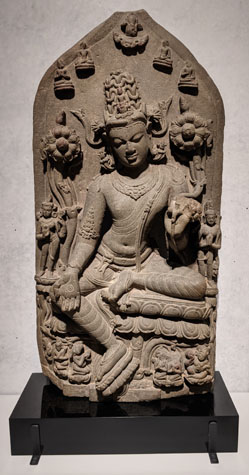
Bohisattva Avalokiteshvara in the Form of Khasarpana Lokeshvara
India, Bihar or Bengal | Pala period, late 11th-early 12th century | Schist
Asia Society, New York | Mr. and Mrs. John D. Rockefeller 3rd Collection | 1979.40

Avalokiteshvara, the bodhisattva of compassion, takes on a wide variety of forms in order to assist the faithful and spread compassion in the world. One of the most important is the esoteric form Khasarpana ('"Sky-Gliding"') Lokeshvara, a bejeweled, youthful deity with the high, matted hair of an ascetic and an image of the Amitabha Buddha on his headdress.

Two standing figures flank the bodhisattva- Tara, a popular female Vajrayana Buddhist deity venerated as an active form of compassion, and Bhirkuti, another manifestation of compassion, with four arms and a stupa in her headdress. The five directional buddhas appear above the bodhisattva's head, four seated on lotus pedestals and one represented by a flaming jewel. Below Lokeshvara's lotus throne are, from left to right: Sudhana, the young pilgrim in search of enlightenment who sought out Avalokiteshvara as a teacher; Suchimukha, a hungry ghost whom the bodhisateva nourishes with nectar that drips from his finger; two donors who supported the production of the sculpture; and Hayagriva, a protective deity who signifies the terrifying but benign power of the buddhas. The elegant proportions, attenuated waistline, and richly carved surface decoration are hallmarks of the Pala style.

(Play Audioguide)


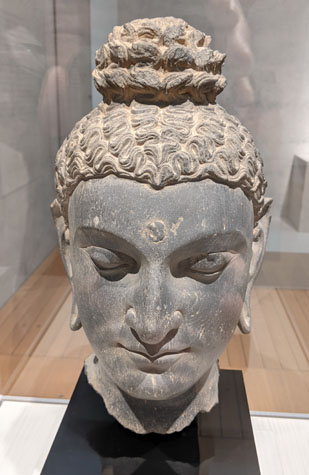
Head of Buddha
Pakistan, Gandhara area | Kushan period, late 2nd-early 3rd century | Schistose phyllite
Asia Society, New York | Mr. and Mrs. John D. Rockefeller 3rd Collection | 1979.2

This head of the Buddha Shakyamuni exhibits a number of characteristics that commonly indicate his perfected nature: the ushnisha, che bump atop the head, represents his cosmic openness as an enlightened being, and the uma, the small circle on his forehead, symbolizes spiritual truth. The Buddha's elongated earlobes refer to his early life as a prince. The holes left by the heavy earrings that he removed when he left his father's palace and renounced material possessions remind the faithful that they, too, should reject worldly pleasures.

Located along the ancient Silk Route, Gandhara (present-day Pakistan) was a geographical crossroads where early influences of the western classical world met with Indian imagery and local practices. In this head, the Hellenistic influence is visible in the finely modeled features and facial structure.


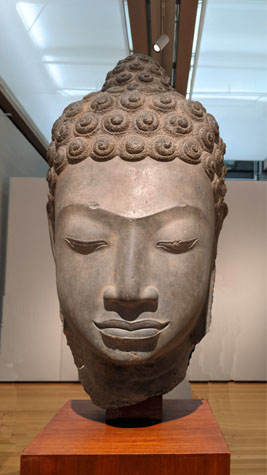
Head of Buddha
Thailand | c. 8th century | limestone
Asia Society, New York | Mr. and Mrs. John D. Rockefeller 3rd Collection | 1979.76

With its high cheekbones, full, wide lips, and broad nose with flared nostrils, this head of the Buddha reflects the influence of the Mon (Dvaravati) people who lived in central Thailand from roughly the sixth to the eleventh century. It also retains much of the iconography for depicting the Buddha developed in India, such as the bump atop the head signifying expanded wisdom (ushnisha) and right-turning, snail-shell curls, which miraculously appeared when Prince Siddhartha Gautama cut off his long hair.


Buddhas and Bodhisativas


By the seventh century, Buddhism was a major religious force across South, East, and Southeast Asia.


The earliest form of Buddhism, known as Theravada (or Hinayana), stressed the teachings and ethics of the historical Buddha Shakyamuni and required disciples to live the austere life of a monk to achieve enlightenment. This was adopted in Sri Lanka and subsequently became the predominant form of Buddhism in Southeast Asia.

A second form of Buddhist doctrine, called Mahayana, allowed everyone, monks and laymen alike, to reach enlightenment by performing good deeds and maintaining sincere faith. In Mahayana, the Buddha Shakyamuni became an eternal supreme being, who was now part of an expanded pantheon of past and future buddhas as well as numerous attendant bodhisattvas. In time, many of these buddhas and bodhisattvas had their own cult followings, including Avalokiteshvara, the bodhisattva of compassion; Maitreya, the Buddha of the Future who presides as a bodhisattva in the Tushita Pure Land Paradise; and Amitabha, the Buddha of Infinite Light and Life, who presides over the Western Pure Land Paradise. Mahayana spread to East Asia, as well as to both South and Southeast Asia.

A third strand, Vajrayana (Esoteric or Tantric) Buddhism, developed cantras, texts involving ritual and mceditational techniques that were used as a means of attaining union with cosmic aspects of the Buddha and attaining enlightenment and ultimately nirvana—tliberation from the endless cycle of rebirth.

The Buddha and enlightened beings known as bodhisattvas are the primary subjects of the works in this gallery. In the centuries immediately following his death, the Buddha was represented in art only by symbols. By the second and third centuries AD, however, the Buddha Shakyamuni was depicted in human form, and his perfected and supernormal nature was indicated through lakshanas, or auspicious marks, such as the ushnisha (bump atop the head), representing his cosmic openness as an enlightened being, and the uma (a circle in the middle of his forehead), a symbol of spiritual truth. Additionally, his clongated earlobes recalled the heavy jewelry he wore during his princely life, and his simple monk's robe served to remind the faithful that to seek enlightenment they must surrender their attachment to worldly goods and pleasures. These features, as well as particular mudras, or hand gestures, also served to identify specific episodes from his life.

Bodhisattvas, although able to escape the endless cycle of birth, death, and rebirth (samsara), choose to remain active in the world to assist others along the path to enlightenment. Artists frequently depict bodhisattvas sumptuously adorned, wearing crowns, headdresses, armbands, and necklaces—alluding to the Buddha's life as a prince before attaining enlightenment. They often have the tall, matted hairstyle of an ascetic. Specific bodhisattvas can be identified by their attributes, such as the objects they hold, or other markers. Avalokiteshvara, the bodhisattva of compassion, the most popular bodhisattva in the Buddhist pantheon, appears in many forms—however, in most, a small, seated Buddha can be seen in the crown.


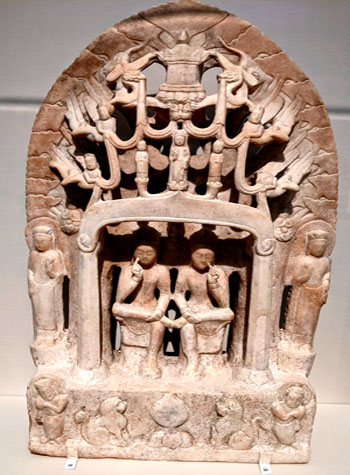
Pair of Bohisattvas in the Pensive Pose
China, Hebei Province | Northern Qi period, dated 570 | Marble
Asia Society, New York | Mr. and Mrs. John D. Rockefeller 3rd Collection | 1992.4

In the sixth century, many Chinese Buddhists were focused on their desire for rebirth in a Buddhist Pure Land- a paradise where the believer could concentrate on Buddhist practice, making inroads toward their ultimate goal of attaining enlightenment in another earthly lifetime. The two central figures on this carving are each seated with one leg resting on the opposite knee and the forefinger of one hand raised to the face in a pensive gesture. Although their exact identification is uncertain, scholars agree that the stele represents bodhisattvas in a paradise, possibly the Tushita Pure Land of the Bodhisattva Maitreya, awaiting rebirth on earth as the Buddha of the Future.

At the base of the stele, a pair of guardians and lions flank what appears to be a large lotus bud. Bodhisattvas stand on either side of those seated. Just above their halos are small beings emerging from lotus buds that may represent souls that have been reborn in the paradise. A small bodhisattva flanked by two monks tops the archway above the seated pair, and the entire sculpture is crowned by flying apsaras (celestial beings) and dragons holding drapery that falls from a reliquary or small stupa.

(Play Audioguide)


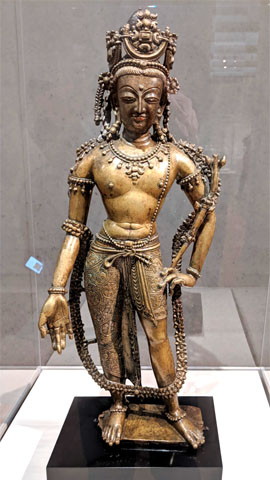
Bodisattva
Western Tibet | Late 10th-early 11th century | Brass with inlays of copper and silver
Asia Society, New York | Mr. and Mrs. John D. Rockefeller 3rd Collection | 1979.45

The proximity of Kashmir to northwestern Tibet and the movement of monks and artists between the two led to the transmission of both faith traditions and artistic styles. This bodhisattva’s long, floral-patterned garment, tied at the hips, relates to imagery from India, but his powerful upper torso and exaggerated waistline echo qualities in the Kashmiri tradition, as do the figure’s broad cyes, arched eyebrows, and trapezoidal facial shape. The bodhisattva’s stance, with legs solidly apart, and the long garland of flowers encircling him from shoulder to ankle are often found in images made in parts of western Tibet.


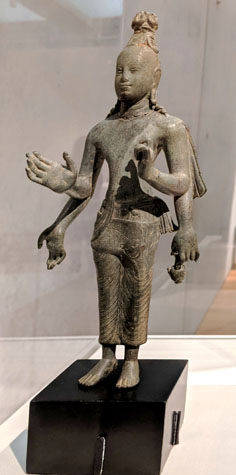
Bodhisattva
Sri Lanka | 7th-8th century | Copper alloy
Asia Society, New York | Mr. and Mrs. John D. Rockefeller 3rd Collection | 1979.41

The island of Sri Lanka is strategically placed along the maritime route that has long connected South and Southeast Asia. This sculpture presents a distinctly Sri Lankan version of an ascetic bodhisattva found in art beyond the Indian mainland, reflecting the movement of new expressions of Buddhism that originated in the subcontinent and were transferred via traders and pilgrims along maritime trade routes. The stiff pose, long waist, large hands, short legs, broad oval face, and hair pulled up in a chignon are frequent features of early Sri Lankan sculpture. The figure wears an animal-skin skirt and holds a spouted bottle called a kundika, an attribute of both Avalokiteshvara and Maitreya.


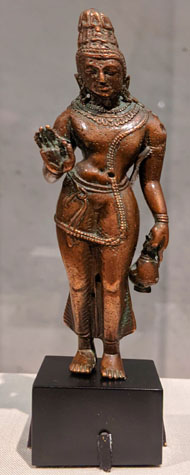
Bodhisattva Avalokiteshvara
Sri Lanka | 8th-9th century | Copper alloy
Asia Society, New York | Mr. and Mrs. John D. Rockefeller 3rd Collection | 1979.81

Two attributes, the kundika flask and the image of a seated buddha in the crown, identify this bodhisattva as Avalokiteshvara. The looped cord over the left shoulder and around the right hip and the rosettes on the arm bands are eighth- or ninth-century Sri Lankan sculptural features. Although the hair piled on the head resembles that seen on ascetic bodhisattvas, the presence of jewelry indicates that this Avalokiteshvara is in princely guise. The clinging skirt revealing the sensuous form of the legs is indebted to India's Gupta style.


Bodhisattva Avalokiteshvara
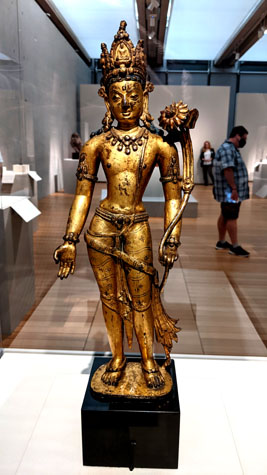
Nepal | Early Malla period, late 13th-early 14th century | Gilded copper alloy
Asia Society, New York | Mr. and Mrs. John D. Rockefeller 3rd Collection | 1979.51

This sculpture is identified as Avalokiteshvara by the Amitabha Buddha in the figure's crown. The bodhisattva of compassion grasps a lotus stem in his left hand and makes the gesture of charity (varadamudra) with his right hand. His pointed crown and jewelry are elaborately modeled. Below his narrow waist, wrapped around his hips, is a garment with a delicate floral pattern that falls below his knees in pointed folds of cloth.

The smooth torso, broad shoulders, and long legs revealed through the clinging cloth reflect the enduring impact of northern India's Gupta style. However, the idealized facia characteristics- the broad face, full cheeks, and elegantly-raised eyebrows above wide-set eyes- identify this sculpture as Nepalese.

(Play Audioguide)


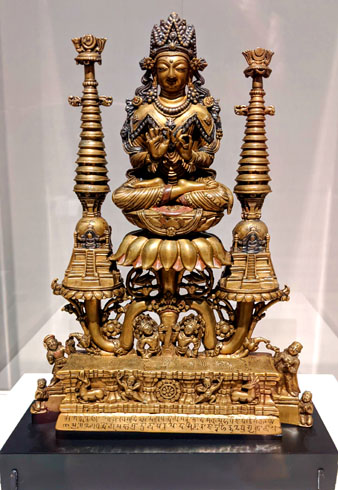
Crowned Buddha Shakyamuni
Kashmir or northern Pakistan | 8th century | Brass with inlays of copper, silver, and zinc
Asia Society, New York | Mr. and Mrs. John D. Rockefeller 3rd Collection | 1979.44

Kashmir was an important crossroads between northern India and parts of central Asia, China, and Tibet. The complex and unique Shakyamuni iconography in this work likely reflects these cultural interactions. Seated upon a lotus that rises from a pond inhabited by Kashmir or northern Pakistan (serpent deities), the Buddha holds his hands in the gesture of preaching (dhannachakramudra). Growing from the locus stem are two stupas, each with a staircase on its four sides leading to a small buddha in a niche. An image of a crescent and sun tops each stupa. The Buddha's elaborate costume and crown indicate that the sculpture depicts the consecration of Shakyamuni as King of the Tushita Pure Land, the abode of all buddhas before their final rebirth on earth. The Sanskrit inscription on the base identifies the donors.

(Play Audioguide)


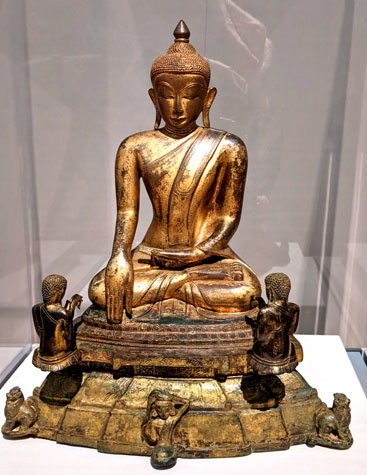
Buddha Shakyamuni with Kneeling Worshipppers
Myanmar | 14th-15th century | Gilt copper alloy
Asia Society, New York | Mr. and Mrs. John D. Rockefeller 3rd Collection | 1979.91a-c

The Buddha Shakyamuni attained enlightenment after a lengthy meditation in which he battled Mara, the god of death and desire. The earth-touching gesture (bhumisparshamudra), seen here, refers to the moment when, challenged by Mara regarding his right to achieve enlightenment, the Buddha reached his right hand down to call the earth to bear witness. In response, the earth, represented here by a female figure on the base, wrung the waters from her hair and swept away Mara and his armies. Two of the Buddha's most important disciples, Mogallana and Shariputra, face the Buddha. Their presence symbolizes the importance of using both skill and knowledge in the search for enlightenment.


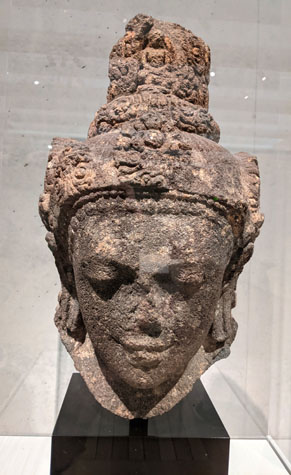
Head of Bodhisattva Avalokitesshvara
Indonesia, Central Java | 9th century | Volcanic stone
Asia Society, New York | Mr. and Mrs. John D. Rockefeller 3rd Collection | 1979.86

The island of Java is almost entirely of volcanic Head of origin, and the several large Buddhist temple Bodhisattva complexes built in central Java under the Shailendra dynasty (flourished 750-850) were Avalokiteshvara constructed from native volcanic stone. This head likely came from one of these complexes.

The broad face is worn, but the headdress with carved ornaments, including five large decorative plaques on the diadem above the forehead and the figure of a small, seated Buddha at the front center of the tall coiffure, are still discernable. This buddha in the diadem is an attribute of the Bodhisattva Avalokiteshvara.


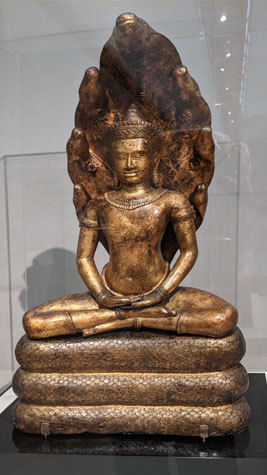
Crowned Buddha Seated in Meditation and Sheltered by Muchilinda
Cambodia | Angkor period, Angkor Wat style, possibly 12th century | Copper allow with recent covering of black and gold lacquer and gold leaf
Asia Society, New York | Mr. and Mrs. John D. Rockefeller 3rd Collection | 1979.68a-c

The serpent played a key role in the mythical origin of the Khmer kings, Buddhist rulers who emphasized their identification with the historical Buddha and thus ruled as buddha-kings. The Angkor period saw the emergence of the image of a crowned and adorned Buddha meditating while seated on the coiled body of the serpent king Muchilinda, protected by his cobra's hood.

The seven-headed serpent king Muchilinda is shown here shielding the seated Buddha Shakyamuni from a fierce storm, an incident that took place during the Buddha's sixth week of meditation after his enlightenment. Therefore, this image may have been understood as both an image of the Buddha and a portrait of a Khmer ruler. In this sculpture, the seated Buddha has both hands in his lap in the gesture of meditation (dhyanamudra), the gesture he also made when he meditated under the Bodhi tree and ultimately attained enlightenment. The cobra base and hood are nineteenth-century replacements. The black lacquer and gold-leaf surface are later additions to the original bronze.

(Play Audioguide)


Ceramics and Metalwork


The appreciation of wines, teas, and cuisine has long traditions in Asia, and the associated ceramic and metal vessels are among the most extraordinary exaples of Asian craftsmanship. Artists and artisans developed a myriad of decorative patterns and forms- from elaborate bronze Chinese offering vessels to simple ceramics for Japanese gatherings- to hold or enhance the visual appeal of food and drink. The surface treatments and materials employed to create these objects, many o fwhich originally came from larger sets, often provide clues to their functions and intended uses in domestic, imperial, and ritual settings.

Archaic Chinese bronzes and precious metal objects have primarily come from burial contexts. Ceramic vessels have survived- and maintained much of their original beauty- due in large part to the development of strong, high-fired wares with equally tough glazes, many of which originated in China. Much as faith traditions spread from India via land and sea trade routes, technological innovations, refinements, and decorative motifs likewise spread from China to other parts of Asia, where they were adopted and adapted by local artists.


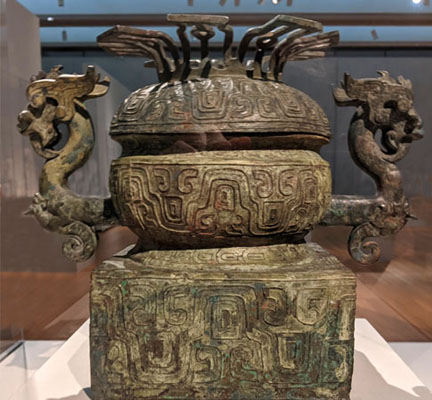
Food Vessel (Gui)
China, reportedly found in Shandong Province | Eastern Zhou period, c. 6th century BC | Copper alloy
Asia Society, New York | Mr. and Mrs. John D. Rockefeller 3rd Collection | 1979.103a-b

Wavelike patterns cover the body, base, and lid of this "gui", a bronze form that first emerged as one of several styles of ritual food vessels during the Shang period (c. 1500-1046 BC). During the following Zhou period, bronzes like this were items of wealth and power. The dramatic crest at the top of the bowl-shaped lid- which, when the lid is removed and set down, becomes a stand- and the regal dragon handles are excellent examples of the sculptural and decorative qualities of many Eastern Zhou-period bronze vessels. During the Shang dynasty, Chinese bronzes began featuring cunning animal motifs that meld and merge. The tiger with curled tails clinging and biting into the curve in the handle are a continuation of this convention.

(Play Audioguide)


Stem Cup
North China | Tang period, c. late 7th-early 8th century | Silver with microscopic traces of gilding
Asia Society, New York | Mr. and Mrs. John D. Rockefeller 3rd Collection | 1979.118

The flourishing mercantile and cultural exchange between China, Central Asia, and Sasanian-period Iran during the seventh through tenth centuries led to an increase in the number of beautifully-shaped and elaborately-decorated objects made of gold and silver. These rare, valuable goods were used by affluent elites, in diplomatic exchanges, and as donations to Buddhist temples. Made by hammering a single sheet of silver into a vessel with eight lotus-petal-shaped panels decorated with an intricate design of flowers and birds, this cup reveals the influence of West and Central Asia in both its method of manufacture and its decoration.


Two Mukozuke Dishes
Japan, Saga and Nagasaki Prefectures | Momoyama to Edo periods, late 16th-early 17th century | Stoneware painted with underglaze iron-brown (Karatsu ware)
Asia Society, New York | Mr. and Mrs. John D. Rockefeller 3rd Collection | 1979.229.1-2

Mukozuke is the Japanese term for the tall, narrow dishes used for serving eel and certain other side dishes during the kaiseki meal that sometimes precedes a formal Japanese tea ceremony. These two mukozuke dishes, probably part of an original set of five, are of Karatsu ware, a high-fired ceramic made near the city of Karatsu on the southern island of Kyushu. Known for their refined stoneware bodies and thin gray glaze, Karatsu wares are often painted with iron-brown pigment (e-garatsu). One of the dishes is decorated with reedlike bamboo, the other with a design of flowing water plantain. Each has a fishnet pattern at the top and the back.


Square Serving Dish with Bail Handle
Japan, Gifu Prefecture | Momoyama period, late 16th century | Stoneware painted on slip with iron-brown underglaze and a partial overlay of copper-green glaze (Mino ware, Oribe type)
Asia Society, New York | Mr. and Mrs. John D. Rockefeller 3rd Collection | 1979.226

Mino wares were made for serving food in association with chanoyu, the Japanese tea ceremony. The ritualized preparation and consumption of tea sometimes involve a kaiseki meal, which is served before a more formal tea ceremony. This serving dish, with its bail-shaped handle and lively asymmetrical decoration, was probably created for serving grilled fish. It is representative of the Oribe type of ceramics popular in early seventeenth-century Japan, named for a famous tea master, Furuta Oribe (1544-1615). Oribe aesthetics include distorted shapes and quirky decorative patterns that may take inspiration from contemporary textile designs. The combination of geometric and nature-inspired motifs and the strategically splashed, bright green copper glaze epitomize the individualism of Oribe ceramics, particularly one-of-a-kind pieces like this.


Tea-Leaf Jar
Nonomura Ninsei (Japanese, c. 1574-1660/66)
Japan, Kyoto Prefecture | Edo period, active c. 1646-77 | Stoneware painted with overglaze enamels and silver (Kyoto ware)
Asia Society, New York | Mr. and Mrs. John D. Rockefeller 3rd Collection | 1979.239 and 251

With a design of elegantly-painted mynah birds with silver and gold embellishments, this jar is an artistic tour de force by one of the few seventeenth-century potters whose name is recognized today, Nonomura Ninsei. Closely associated with a renowned tea master, Kawamori Sowa (1585-1656), Ninsei created ceramics for Sowa's tea ceremonies and cultural gatherings. His sophisticated ceramics perfectly expressed the kind of kirei (refined beauty) Sowa strove to include in his tea ceremonies. Despite its utilitarian form, with four lugs on its shoulders for securing a lid, this tea-leaf jar was more likely intended for aesthetic appreciation rather than actual use. The sweeping vision of the overall composition, along with the vivid realism of the birds- who stand, fly, and squabble- exemplifies Ninsei’s affinity for the art of screen painting.

(Play Audioguide)


Bowl
Japan, Saga Prefecture | Edo period, c. 1670-90 | Porcelain painted with overglaze enamels, with traces of gold (Arita ware, Kakiemon style), and 18th-century gilded bronze mounts
Asia Society, New York | Mr. and Mrs. John D. Rockefeller 3rd Collection | 1979.91a-c

The city of Arita on the southern island of Kyushu became the world's largest and most important center for porcelain production in the seventeenth century. At this time, European customers for porcelain turned from China, which was experiencing civil upheaval, to Japan. Japanese porcelains continued to dominate the European market until the mid-eighteenth century, when Europeans resumed major porcelain trade with China. This bowl is indicative of the porcelains so highly prized and sought after by Europeans during this period. It was formerly in the collection of Augustus the Strong, Elector of Saxony and King of Poland (reigned 1694-1733), an avid collector of Asian porcelain. The custom-made gilt-bronze mounts, probably manufactured in Germany, attest to how highly porcelains were regarded in Europe.


Dish
Japan, Saga Prefecture | Edo period, 17th Century | Porcelain painted with underglaze cobalt blue with Iron-brown and green glazes (Arita ware, Nabeshima type)
Asia Society, New York | Mr. and Mrs. John D. Rockefeller 3rd Collection | 1979.248 and 237

"Nabeshima ware" refers to the porcelains made at kilns operated directly by the Nabeshima clan, the rulers of the Saga domain. Both decorative and functional, this refined porcelain was produced in extremely limited quantities and intended solely for the clan's own use or as gifts to the shogun, feudal lords, and the nobility. It is characterized by precise, arresting, and uniquely Japanese designs, often featuring motifs found in nature and in Japanese textiles and frequently presented in asymmetrical compositions. Here, the combination of cherry trees and curtains may refer to outdoor viewing spaces for cherry blossom viewing parties, popular in spring.

The technical prowess of Nabeshima porcelain is evident in the combination of underglaze blue with iron-brown and green glazes, which melt ae different temperatures, therefore requiring separate firings.


Bowl with Reticulated Rim
Ogata Kenzan (Japanese, 1663-1743)
Japan, Kyoto Prefecture / Edo period, early 18th century
Stoneware with pierced design and painted with slips, underglaze and overglaze enamels, and gold (Kyoto ware)
Asia Society, New York | Mr. and Mrs. John D. Rockefeller 3rd Collection | 1979.239 and 252

Ogata Kenzan, mentored by Nonomura Ninsei, whose Tea-Leaf Jar is on view nearby, was one of the most successful artist- potters of the Edo period. Kenzan’s tea wares- including trays, dishes, and bowls- are known for their bold decorative designs and strong silhouettes. A sprawling scene of golden wild geese circling among white mists, green bamboo, and black riverbanks envelops the exterior and interior surface of this perforated, deep bowl. The elaborate and colorful decoration reflects Kenzan's own flair. The bow] has the potter's signature on the base, signaling an important shift in the practice of ceramic art in Japan. Ninsei and Kenzan were among the first Japanese potters to sign their works, indicating the expectation that ceramic artists should be as highly regarded as the pieces they produced.


Storage Jar
Vietnam, possibly Champa / 15th-16th century
Stoneware with incised design underglaze (Go-sanh ware)
Asia Society, New York | Mr. and Mrs. John D. Rockefeller 3rd Collection | 1979.248 and 96

This storage jar with a boldly incised design of flowers and foliage was most likely intended as a functional rather than purely decorative object; the lugs just below the neck helped anchor some type of cover. Jars such as this contained foodstuffs and other wares that merchants often transported and traded across the South China Sea to other parts of Southeast Asia.

The potters at the Go-sanh kilns produced wares with distinctive butterscotch-colored glazes and incised decoration for centuries during and after the rule of the kingdom of Champa (192-1471). The strategic location of Champa along the Vietnamese coast made it an important port on the trade routes that linked mainland Southeast Asia with Indonesia, China, and other parts of the world from at least the eighth century.


Jar
Thailand / 14th century
Stoneware with incised and applied design underglaze
Asia Society, New York | Mr. and Mrs. John D. Rockefeller 3rd Collection | 1979.239 and 1979.95

The shape of this glazed jar, with a wide mouth, slender neck, and broad shoulders tapering to a smaller foot, as well as the two bands of incised vertical zigzag marks, suggest it may have been produced in northern to central Thailand, where related ceramics have been found. This jar has a form that was sometimes used for funerary urns, and it was filled with many metal and terracotta vouve tablets when it was unearthed. Funerary urns of similar shape were produced at kilns controlled by the Khmer empire of Cambodia; it is possible that this jar reflects the influence of a Khmer prototype or, at the very least, is evidence of the interrelationship of contemporaneous ethnic groups in mainland Southeast Asia that exchanged goods and ideas.


Dish
China, Jiangxi Provine / Qing period, Yongzheng era (1723-35)
Porcelain painted with overglaze enamels (Jingdezhen ware)
Asia Society, New York | Mr. and Mrs. John D. Rockefeller 3rd Collection | 1979.239 and 1979.188

The beautiful shapes, refined bodies, sophisticated colors, and elegant painting that characterize Qing-period porcelains are embodied in this dish. It is decorated with an auspicious design, extending from the exterior to the interior, of five bats and eight peaches hanging from blossoming branches. In Chinese, wufu (five bats) is a homonym for the phrase “Five Happinesses” and thus symbolizes them: wealth, health, longevity, a virtuous life, and a natural death. The eight peaches combine an auspicious number with a fruit that symbolizes longevity.

An important element in Qing-period painted porcelains is the addition of shades of pink to the overglaze enamel palette. An opaque white derived from a lead arsenite and a pale pink from colloidal gold were among the last opaque overglaze enamels to be developed, possibly because they are very difficult to manufacture. This palette of colors that includes pale shades of green and pink is called "fencai" (powdery colors) or "mancai" (soft colors). In the West, it is known as "famille rose" (pink family).

(Play Audioguide)


Bowl
China, Jiangxi Province / Qing period, Yongzheng era (1723-35)
Porcelain painted with overglaze enamels (Jingdezhen ware)
Asia Society, New York | Mr. and Mrs. John D. Rockefeller 3rd Collection | 1979.248 and 1979.186

In its range of opaque overglazed enamel colors, this elegantly painted bowl exhibits the amazing breakthroughs in color availability that occurred during the Qing period. This was a time when European Jesuits served at court, and Chinese artists collaborated with their counterparts in imperial workshops. The wide range of colors available to porcelain painters at this time appears in the varied hues of the landscape and flora, as well as in the delicately painted feathers of the two quail standing upon green grass. The rocky landscape on this bowl, consisting of a Chinese red-berry shrub, narcissus, rocks, and lingzhi fungus (reputed to confer immortality when ingested), suggests that it was meant to convey birthday or New Year’s greetings. Here, the artist joined these sentiments with another auspicious theme: the paired quails (shuang an), which can be read as a rebus for "peace" and "prosperity". The composition of the painting around the exterior of the bowl reveals itself, like that of a Chinese handscroll, as the viewer turns the object.


Covered Jar
China, Jiangxi Provine / Ming period, Jiajing era (1522-66)
Porcelain painted with underglaze cobalt blue and overglaze enamels (Jingdezhen ware)
Asia Society, New York | Mr. and Mrs. John D. Rockefeller 3rd Collection | 1979.1979.239 and 1979.182a,b

(Play Audioguide)

Decorated with an animated scene of goldfish swimming in their natural habitat, this covered jar exemplifies the wueai, or “five-color” technique. Rather than relying completely on outlines of underglaze blue for the design, artists instead painted colored enamels directly onto the fired glaze, which allowed them to work in a freer and more detailed manner. The subject matter is filled with auspicious symbolism: fish swimming in nature imply harmony, while eight fish constitute a visual pun for "vast fortune" because the Chinese pronunciation of the two phrases is similar. The bold and lively movement of the fish and aquatic plants on this jar typifies a new aesthetic in early sixteenth-century imperial ceramics. Its large size and thick potting indicate that it may have been used as an outdoor garden decoration.


Bowl
China, Jiangxi Province / Ming period, Chenghua era (1465-87)
Porcelain painted with underglaze cobalt blue (Jingdezhen ware)
Asia Society, New York | Mr. and Mrs. John D. Rockefeller 3rd Collection | 1979.248 and 1979.172

This Chenghua-era "palace bowl" possesses the thin potting, the lightly applied, slightly honey-colored, clear, smooth glaze, and the precise painting for which blue-and-white porcelains of this era are so admired. Six large chrysanthemum blossoms and six smaller, partially opened blossoms are fluidly linked by exceptionally fine and exquisite scrolling vines and delicately veined leaves in a continuous line, with no clear beginning or end to the pattern. The naturalistic design has been carefully placed to cover the exterior of the bowl and to suggest the organic movement and growth of actual plants. Flowers on porcelains generally have auspicious meanings, and the chrysanthemum, a symbol of autumn in China, also has associations with long life, fidelity, and joy.


Bowl
China, Jiangxi Provine / Ming period, Chenghua era (1465-87)
Porcelain painted with underglaze cobalt blue (Jingdezhen ware)
Asia Society, New York | Mr. and Mrs. John D. Rockefeller 3rd Collection | 1979.239 and 1979.171

Many collectors of Chinese blue-and-white porcelain consider the high-quality works of the Ming Chenghua era the finest ever produced. These ceramics have thin, luminous porcelain bodies with carefully painted designs. Bowls painted with precise and fluid floral motifs, such as this one, are known to connoisseurs as "palace bowls" and are characteristic of the reign of the Chenghua emperor.

A stylized pattern of six large lotus blossoms linked by scrolling leafy vines surrounds the outside of the bowl. In China, the lotus is an emblem of summer and is also associated with purity and integrity. The curving vines are in visual harmony with the curved silhouette of the bowl. The foot ring is fittingly embellished with a stylized blue-and-white decoration of undulating water.


Platter
China, Jiangxi Province / Yuan period, mid-14th century
Porcelain painted with underglaze cobalt blue (Jingdezhen ware)
Asia Society, New York | Mr. and Mrs. John D. Rockefeller 3rd Collection | 1979.248 and 1979.151

(Play Audioguide)

By the mid-fourteenth century, the kilns at Jingdezhen in Jiangxi province were producing porcelains decorated with cobalt blue under a clear glaze for both domestic and export markets. On this platter, messages of good fortune and blessing are conveyed by the mythical Chinese qilin (a unicorn-like creature), which is surrounded by bamboo, morning glories, plantains, and melons. The density and complexity of the design and the platter's large size- intended for communal dining- are characteristic of wares made for export to the Middle East. An inscription engraved on the outside of the foot ring names the Mughal emperor Shah Jahan (reigned 1627-1658) and gives a date corresponding to 1652/1653 in the Western calendar, making this one of the few examples of Yuan-period porcelain known to have been preserved in India.


Bowl
China, Jiangxi Provine / Ming period, Xuande era (1426-35)
Porcelain painted with underglaze cobalt blue and copper red (Jingdezhen ware)
Asia Society, New York | Mr. and Mrs. John D. Rockefeller 3rd Collection | 1979.239 and 1979.167

Ceramics were first employed for imperial dining in the early fifteenth century, leading to the creation of new shapes and increased production for daily use. The shape of this thinly potted bowl suggests it was once part of a large set of dishes used for this purpose.

The combination of two high-fired colors, cobalt blue and copper red, was an innovation of the Xuande era and was reserved for particularly luxurious works. In the fifteenth century, the motif of a dragon chasing a pearl became a prominent imperial symbol in the arts. The two five-clawed dragons encircling this bowl indicate that it was intended for use by the emperor. The flaming pearl may represent the sun or the moon, both symbols of the power of the emperor.


Bowl
China, Jiangxi Province / Ming period, Xuande era (1426-35)
Porcelain painted with underglaze cobalt blue (Jingdezhen ware)
Asia Society, New York | Mr. and Mrs. John D. Rockefeller 3rd Collection | 1979.248 and 1979.162

This six-lobed bowl is painted with elegantly placed and painted images of fruits and flowers. Six large clusters of litchis, peaches, loquats, pomegranates, persimmons, and grapes, with six small sprays of camellias, cherries, and chrysanthemum below, encircle the exterior of this bowl, while a scrolling pattern covers its low foot ring. On the interior of the bowl, a flowering branch is painted in the center, surrounded by six large sprays of flowers: lotuses, camellias, chrysanthemums, and peonies. Just above is a band of twelve small floral sprays.

The delicate sense of vitality of these fruits and flowers, as well as the ease of their careful placement over the surface of the bowl, which gives the design a subtle sense of movement and naturalness, characterize the decoration of Xuande-era porcelains.


Bowl
China, Jiangxi Provine / Ming period, probably Xuande era (1426-35)
Porcelain painted with underglaze cobalt blue (Jingdezhen ware)
Asia Society, New York | Mr. and Mrs. John D. Rockefeller 3rd Collection | 1979.239 and 1979.169

The form and decoration of this large bowl reflect carly fifteenth-century Chinese imperial tastes in ceramics. Fluently brushed and carefully ordered clusters of camellias, litchis, peaches, peonies, and chrysanthemums encircle the interior of the bowl, while two large pomegranates fill the bottom. A vine with large and small lotus blossoms scrolls around the exterior. Corresponding imagery embellishes the interior and exterior bands below the bowl's mouth. The careful placement of these motifs, their calligraphic treatment, and the openness of the composition characterize Muande-era porcelains.

During this period, the cobalt used tor the underglaze decoration was imported from the Middle East or Central Asia; its precipitation into the glaze resulted in the characteristic "heaped-and-piled" effect of thick, dark areas within the painting.


Wine Cup
China, Jiangxi Province / Ming period, Chenghua era (1465-87)
Porcelain painted with underglaze cobalt blue and overglaze enamels (Jingdezhen ware)
Asia Society, New York | Mr. and Mrs. John D. Rockefeller 3rd Collection | 1979.248 and 1979.175

(Play Audioguide)

Among the most prized Chenghua-era porcelains are small, delicate,thinly potted wine cups embellished with a combination of underglaze cobalt blue and overglaze enamels. This cup was decorated using a rare technique known as doucai, or "joined-colors." In this method, the main outlines of the design are painted directly onto the unglazed body in cobalt blue before the porcelain is glazed and fired. Colored enamels are painted over the glaze to fill in the outlined shapes, and a second firing at a lower temperature fixes these enamels.

On this cup, the deep red and delicate shades of green, yellow, and blue overglaze colors add vibrancy to the motifs of dragons in floral medallions and floating flowers, which stand out against the luminous white of the glazed porcelain.


Dish
China, Jiangxi Provine / Ming period, probably Chenghua era (1465-87)
Porcelain with copper-red glaze (Jingdezhen ware)
Asia Society, New York | Mr. and Mrs. John D. Rockefeller 3rd Collection | 1979.239 and 1979.177

The development of the bright copper-red glaze on this dish, known as jihong (sacrificial red), was among the Ming dynasty’s artistic achievements. However, red-glazed porcelains of the period are extremely rare, as the red color of the glaze was very difficult to achieve. Standard for copper-red porcelains, the white of the body is exposed at the rim of the plate, as gravity left the glaze at the rim so thin that there is too little colloidal copper to allow the red color to emerge.

According to historical records, red was considered a symbol for the sun, and red-glazed vessels were used at the altar of the sun in the imperial capital, Beijing. Red was also the banner color of the Ming imperial family, whose surname, Zhu, can be translated as "red."


Stem Cup
China, Jiangxi Province / Ming period, Chenghua era (1465-87)
Porcelain painted with underglaze cobalt blue and overglaze red enamel (Jingdezhen ware)
Asia Society, New York | Mr. and Mrs. John D. Rockefeller 3rd Collection | 1979.248 and 1979.176

Chenghua-era porcelains are known for their refined white bodies and delicately painted decoration. The stem cup, essentially a short bowl mounted on a tall foot, has traditionally served ceremonial purposes in China; such cups are often placed on ritual altars. On the exterior of this example, blue-winged creatures fly above overglaze-red waves, perhaps a reference to China’s position in the fifteenth century as the world’s preeminent seafaring empire. In addition to the winged dragon at the interior base of the bowl, the creatures on the outside include winged fish, elephants, horses, and deer. The leiwen (thunder scroll) band just below the exterior lip of the cup recalls a decorative pattern frequently found on ritual bronzes of the Shang dynasty (1600-1046 BC)- an allusion to China's ancient past.


Brush Washer
China, Henan Provine / Northern Song period, early 12th century
Stoneware with glaze (Jun ware)
Asia Society, New York | Mr. and Mrs. John D. Rockefeller 3rd Collection | 1979.239 and 1979.138

(Play Audioguide)

The historical Chinese practices of painting and calligraphy both rely on the employment of water-soluble ink and pigments, most often applied to paper or silk. Chinese artists and scholars employ brush washers to moisten or rinse out their brushes as they paint or write. The ring handle allows the small, shallow bowl to be carried securely. The simple elegance of the form, the thick, pale blue-gray glaze, and the fine crazing- caused by the glass shrinking more than the clay as the object cools after firing- are characteristics cherished by the Northern Song Imperial court. Jun ware has also been highly regarded by Japanese and Western collectors.


Bowl
China, Henan Province / Northern Song period, 12th century
Stoneware with glaze with suffusions from copper filings (Jun ware)
Asia Society, New York | Mr. and Mrs. John D. Rockefeller 3rd Collection | 1979.248 and 1979.137

The blue shades of this bowl, which is probably intended for drinking tea, are an optical effect that results from the extremely minute light-scattering droplets of glass that formed in the fired glaze. The bright purple splashes were caused by the addition of copper filings that were brushed onto the glaze prior to firing. The primary patrons of Jun Ware were households with significant incomes. The pieces are usually everyday wear, like this bowl, but some were also specially made as functional items for temples and palaces or for tribute.


Cusped Bowl
China, Shaanxi Province / Northern Song period, c. early 12th century
Stoneware with combed and incised design underglaze (Yaozhou ware)
Asia Society, New York | Mr. and Mrs. John D. Rockefeller 3rd Collection | 1979.239 and 1979.131

High-fired, green-glazed ceramics, derived from iron oxides, were among the earliest glazes to be produced in China. Song-dynasty Yaozhou wares are noted for their deeply carved, incised designs and thick olive glazes. This rare cusped bowl is decorated with fluidly carved motifs. A design of peonies and leaves on both the interior and exterior, with finer carved and combed lines enhancing the details of the peony petals, and a layer of combed lines below the twelve-lobed bowl rim result in a great complexity of pattern. The relatively thinly applied glaze pools in the carved areas, creating a darker contrast with the lighter green areas, where more of the color of the light gray ceramic body shows through.


Censer
China, Zhejiang Province / Yuan period, 13th-12th century
Stoneware with glaze (Ge ware)
Asia Society, New York | Mr. and Mrs. John D. Rockefeller 3rd Collection | 1979.239 and 1979.146

Ancient Chinese bronze ritual vessels known as gui (one of which is on view in this gallery) inspired the form of this rare censer, or incense burner. Of a type known as Ge ware, the vessel's dark body is covered by a thick gray-green glaze with prominent crazing, enhanced by the application of ink. Created for the court of the Southern Song dynasty, the reference to the ancient past reflects the powerful Chinese elites' love of archaism and taste for collecting antiquities.


Bottle
China, Jiangxi Province / Ming period, early 15th century, probably Yongle era (1403-24)
Porcelain painted with underglaze cobalt blue (Jingdezhen ware)
Asia Society, New York | Mr. and Mrs. John D. Rockefeller 3rd Collection | 1979.239 and 1979.156

(Play Audioguide)

Among the most famed and frequently produced ceramics during the Yongle era are those with a warm white glaze known as tian bai (sweet white ware). The decoration on the bottle is difficult to see- an extremely delicate incised pattern of a stylized lotus flower near the center of the back and front. This kind of finely-worked pattern, known as anhua (hidden decoration), was popular on Yongle-period white ware.

This bottle's flattened gourd shape is derived from Middle Eastern metalwork and ceramic flasks. The combination of a foreign shape with a Chinese design highlights the cross-cultural dialogue in the newly reopened ceramic trade during the Ming dynasty.


Flask
China, Zhejiang Province / Yuan period, 13th-12th century
Stoneware with glaze (Ge ware)
Asia Society, New York | Mr. and Mrs. John D. Rockefeller 3rd Collection | 1979.239 and 1979.146

A dynamic, three-clawed dragon stretches across either side of this impressive flask. The dragons prance against a backdrop of floating, scrolling lotus vines that populate their natural habitat, whether sea or sky. Classic early Ming-style dragons, they have massive heads with upturned snouts, strong serpentine bodies, and large scales. Chinese dragons are powerful but benign creatures long associated with the emperor. During the Ming period, objects with three-or four-clawed dragons functioned as imperial gifts to members of the court or to foreign rulers and dignitaries. Similar large flasks are in collections in Tehran and Istanbul, suggesting this one was likely created for the export market.


Jar
China, Jiangxi Province / Ming period, late 14th century
Porcelain with underglaze copper red (Jingdezhen ware)
Asia Society, New York | Mr. and Mrs. John D. Rockefeller 3rd Collection | 1979.239 and 1979.153

In addition to ceramics painted with underglaze blue, pieces decorated with underglaze copper were also produced at the kilns of Jingdezhen, the center of China’s ceramic production since the fourteenth century. Copper pigment is very sensitive to temperature, and therefore the red color is difficult to achieve; in fact, the grayish tones of the red on this jar indicate that it was overfired. The central section of this jar is decorated with a profusion of flowers and plants including a pine tree, a plum tree, and bamboo, or the "three friends of winter," which flourish under adverse conditions and are symbols of longevity, perseverance, and integrity- all the virtues of the ideal scholar-genteman. The jar was no doubt an expensive item created for the household of someone from the educated elite or perhaps the court.


Dish
China, Hebei Province / Northern Song period, early 12th century
Porcelain with molded design underglaze (Ding ware)
Asia Society, New York | Mr. and Mrs. John D. Rockefeller 3rd Collection | 1979.248 and 1979.140

The thin body and sophisticated design of this dish were the result of innovations made in the Ding kilns of north China. New techniques were used to prevent ceramics from warping and sticking to one another during firing, and the introduction of molds allowed more efficient production. The dragon was a common symbol of imperial power in China, and its presence on the interior of this high-quality Ding ware dish, with its impressed design of a four-clawed dragon chasing a pearl among swirling clouds, suggests an imperial connection. The design is particularly crisp and even, indicating that the mold was fresh and very carefully applied.


Jar
North China / Tang period, 8th-9th century
Stoneware with glaze
Asia Society, New York | Mr. and Mrs. John D. Rockefeller 3rd Collection | 1979.239 and 1979.130

This wide-mouthed vessel with an out-turned lip and a bulbous body likely served as a storage jar. The presence of two handles, which were probably used not to hold the jar but to help secure a cover on it, offers further evidence of its use. Each of these wide, curved handles terminates in a pointed leaf-shaped end that is pressed against the shoulder of the jar. The upper part of the body and the interior are coated with a layer of dark brown glaze, while the lower portion of the body was left unglazed.


Brush Washer
North China / Northern Song period, late 11th-early 12th century
Stoneware with glaze with iron "oil spots"
Asia Society, New York | Mr. and Mrs. John D. Rockefeller 3rd Collection | 1979.248 and 1979.144

This brush washer, a shallow bowl used to rinse calligraphy or painting brush, exhibits the rich, dark glaze characteristic of black wares made in north China in the Northern Song period. The silvery spots result from an excess of iron particles in the glaze, which rise to the surface during firing; a drop in kiln temperature fixes the spots in place. Bowls with this "oil-spot" glaze were often preferred for the ritual drinking of tea and were associated with Zen (in China, Chan) Buddhism. Known in Japan as temmoku, these types of black wares were widely admired, collected, and imitated.


Bottle
North China / Northern Song period, late 11th-early 12th century
Stoneware with slip and trailed-slip underglaze (Cizhou ware)
Asia Society, New York | Mr. and Mrs. John D. Rockefeller 3rd Collection | 1979.239

The flared lip of this bottle suggests it was likely used for serving wine, as its shape would have facilitated pouring. The squat form characterizes ceramics of the Song period. Potters created its sections-bottom, top, and neck and mouth- separately on the wheel and then assembled them into the final form. The decorative ribs were added by applying trailing lines of thick, white slip down the surface of the pot. The bottle was covered with a light brown glaze that is thinner and lighter in color on the raised ribs and appears almost black where it is densest.


Bottle
North China, probably from Xiuwu or Cizhou / Northern Song period,
late 11th-early 12th century
Stoneware with sgraffito design in slip underglaze (Cizhou ware)
Asia Society, New York | Mr. and Mrs. John D. Rockefeller 3rd Collection | 1979.248

Bottles of this shape, known as meiping, may have been used for storing and serving wine. This container is among the finest examples of Cizhou ware—a ceramic type produced for popular consumption in north China. The bold peony patterns that decorate the robust body of the vase were created using the sophisticated sgraffito technique: the body of the vessel was coated first with a white slip (or clay wash) and then with a black slip. After incising the outlines of the design into the black slip, the artist shaved away the darker material to reveal the white underneath. The technical execution of this decoration suggests that the vessel was intended to be enjoyed for the visual pleasure it would give as much as for its functionality.


Footed Dish
North China / Tang period, 8th century, probably Yongle era (1403-24)
Earthenware with multicolored lead glazes and traces of pigment (sancai ware)
Asia Society, New York | Mr. and Mrs. John D. Rockefeller 3rd Collection | 1979.239

(Play Audioguide)

The form of this three-footed carthensware dish derives from similar metalwork pieces from Iran and western Central Asia. While the blue clouds are a traditional Chinese motif, the stylization of the flower at the center of the dish into geometricized shapes reflects foreign aesthetics. These designs were stamped into the clay, and the white dots resulted from applying a glaze-resistant material. The low-fired multicolored lead glazes used to decorate this piece are known as three-color or sancai glazes. Sancai pieces are among the best-known and finest examples of ceramics from the Tang period.


Figure of a Court Lady
North China / Tang period, 8th century
Earthenware with multicolored lead glazes and traces of pigment (sancai ware)
Asia Society, New York | Mr. and Mrs. John D. Rockefeller 3rd Collection | 1979.239

For many centuries, Chinese elites commissioned minggi (spirit goods) for the tombs of their deceased family members. These low-fired earthenwares served as surrogates for the actual humans, animals, and objects needed to ensure that the tomb's inhabitants preserved their social and economic status in the afterlife and to keep the spirits of the deceased content. Likely part of a large ensemble representing court musicians, this seated court lady wears a high-waisted dress of the period and holds a pair of cymbals. The generous application of cobalt blue glaze, an expensive pigment imported to China from Iran in the eighth century, indicates that no expense was spared.


Foliate Bowls and Saucers
Korea, South Jeolla Province / Goryeo period, early 12th century
Stoneware with glaze
Asia Society, New York | Mr. and Mrs. John D. Rockefeller 3rd Collection | 1979.193.1-4

(Play Audioguide)

The highly refined, green-glazed stoneware created by potters during the Goryeo dynasty (918-1392) was the first Korean ceramic to become internationally renowned for its extraordinary craftsmanship. This rare pair, part of a larger set, may have been used as containers for delicacies during dinners or banquets at the court. The graceful and crisply articulated floral shape of these bowls, which recalls the form of a lotus or chrysanthemum, and the stunning color of the glaze indicate that these pieces were luxury goods. The translucency and density of the glaze and the intentional, subtle crackles over the surface add to the piece's allure and make them among the most important surviving green-glazed Korean ceramics of the period.


Storage Jar
Korea / Joseon period, c. mid-18th century
Porcelain painted with underglaze cobalt blue
Asia Society, New York | Mr. and Mrs. John D. Rockefeller 3rd Collection | 1979.196

Blue-and-white porcelain was first introduced to Korea from China in the fifteenth century. Ac that time, it was exceedingly rare in Korea, and its consumption was legally restricted to the royal court. By the mid-eighteenth century, blue-and-white porcelain had reached consumers well beyond imperial patrons. The symbols of longevity that adorn this large jar- the pine tree, crane, lingzhi (longevity-inducing fiingus), and moon- were tremendously popular at all levels of Joseon society. However, this combination on a porcelain, underglaze-cobalt-blue storage jar is rare; no other examples are known. The slightly irregular shape and the freely executed decoration, adapted from folk painting, indicate that it may have been intended for the wealthy literati rather than for the imperial court.

Another category of ceramics and metalwork of which there are numerous examples in the Rockefeller collection are the representations of the human figure. These works are decorative, rather than utilitarian, and were used in homes and other buildings as we might use small statues as decorative elements in bookcases or on tables. In addition to human figures, there are examples of other decorative (and sometimes utilitarian) objects.


Kneeling Woman
Japan, Nara Prefecture, Horyuji | Nara period, early 8th century | Clay with traces of slip and pigment
Asia Society, New York | Mr. and Mrs. John D. Rockefeller 3rd Collection | 1979.200

This small clay sculpture may have originally been part of a larger group of clay figures on the first story of the five-story pagoda Horyuji, in Nara prefecture, one of the earliest and most important Buddhist temple complexes in Japan. Cultural transmission from China to Japan was strong during the Nara period, when artisans produced the Horyuji pagoda sculptures. For this reason, it is not surprising that the wide sleeves of the kneeling woman's gown and the long sash tied at the front followed prototypes seen in Chinese sculptures of women dating from the late seventh and early eighth centuries.


Male Attendant Figure
Japan | Kamakura period, early 14th century | Gilded copper alloy
Asia Society, New York | Mr. and Mrs. John D. Rockefeller 3rd Collection | 1979.203a-b

The introduction of Buddhism to Japan via Korea in the sixth century had a profound effect on Japanese history, art, and culture. This small sculpture shows a young man with his hair in two looped braids, one over each ear, wearing trousers under a heavy outer robe. Similar features are found on attendant figures (déji) that make up part of Japanese Buddhist temple tableaux. While the man's bent arms suggest that he was originally carrying something, it may not have been similar to the box he is currently holding in his bands and the box are twentieth-century replacements.


Two Standing Female Figures
Japan, Saga Prefecture / Edo period, c. 1670-90
Porcelain painted with overglaze enamels, one figure also with traces of gold (arita ware, Kakiemon style)
Asia Society, New York | Mr. and Mrs. John D. Rockefeller 3rd Collection | 1979.240

(Play Audioguide)

Porcelain sculptures of elegantly coiffed and attired courtesans, called bijin (beautiful women), were among the wares manufactured at the Arita kilns on the southern island o fKyushu. These sculptures found many admirers in Europe, where they remain treasured objects in public and private collections. The black eyes and eyebrows, red lips,and white facial complexions of these figures have been carefully rendered. Their hair, in the gosho-mage (palace chignon) style, is held with an ornamental pick in the Edo-period fashion that most likely originated at court. One woman wears an outer kimono with the design of large chrysanthemum blossoms floating atop a winding stream, while the other wears one decorated with delicate wisteria sprays. Both of their inner kimonos are decorated with a Chinese arabesque motif (karakusa) but with the red/white coloring in reverse.


Drum-shaped Pillow
Japan, Saga Prefecture / Edo period, late 18th-early 19th century
Porcelain painted with overglaze enamels and gold (Arita ware, Imari style)
Asia Society, New York | Mr. and Mrs. John D. Rockefeller 3rd Collection | 1979.239

The development of porcelain production in Japan is linked to the contributions of technically advanced Korean potters who came to Japan in the late sixteenth century. It was at this time that Arita established itself as the most important center for porcelain production in the world, supplying ceramics for both domestic consumption and export. This drum-shaped pillow is decorated in overglaze enamels with a restrained pattern of white cherry blossoms against the bold red color typical of the so-called Imari style. Red chrysanthemums with gold highlights border the dominant cherry blossom pattern. Both flowers have long been popular decorative motifs in Japan. Neck pillows like this one were made for fashionable women to protect their elaborate coiffed hair as they slept.


Male and Female Figures
Cambodia / Angkor period, late 12th-early 13th century
Sandstone
Asia Society, New York | Mr. and Mrs. John D. Rockefeller 3rd Collection | 1979.72.1-2

This handsome male and female pair exhibit the oval heads and slightly elongated figures that exemplify sculpture from the end of the Angkor period. The artist paid particular attention to lifelike details in the subtly developed musculature in the male's right thigh, the figures' slight smiles, which raise the flesh of their cheeks, and their downward gazes, suggesting the inwardness of meditation. This less stylized, more naturalistic treatment of the body is also typical of late Angkor sculpture. Neither figure displays attributes that would identify them as specific deities, royalty, or a combination of the two. Nevertheless, the heavy earrings, elaborate belts, and the crown on the male suggest that they are figures of power.


Gods and Kings


Hinduism and Buddhism both originated in India and spread through the sacred languages of Sanskrit and Pali. Traders, missionaries, and scholars from India and Sri Lanka introduced these belief systems and their imagery to the kingdoms of Southeast Asia- including the countries that we know today as Indonesia, Thailand, Myanmar (Burma), and Cambodia- creating ties that began as early as the first century.

Blended with indigenous beliefs, aspects of Indian Hinduism and Buddhism were incorporated into the art and architecture of Southeast Asia. Even in kingdoms where one of these belief systems came to dominate, deities from the other religion also found an important place. Often the same artist made sculptures for both religions. Geographic and political ties among Hindu and Buddhist kingdoms led to further cultural and artistic exchange, the effects of which can be seen in this gallery.

Rulers and wealthy patrons supported the production of impressive icons from expensive, highly refined materials and the creation of Hindu and Buddhist temples to house them. Moreover, the Hindu and Buddhist rulers of Southeast Asia frequently asserted their power by constructing a capital city with a temple at the center, providing a state setting for the representation of deities. These acts were demonstrations of their worldly power, but, perhaps more importantly, patrons carried them out with the expectation that they would be rewarded in the afterlife.


Shiva
Cambodia / Angkor period, 11th century / Sandstone
Asia Society, New York | Mr. and Mrs. John D. Rockefeller 3rd Collection | 1979.239

(Play Audioguide)

Angkor was the capital city of the great Khmer empire that ruled large parts of mainland Southeast Asia from the ninth to the early fifteenth century. The Khmer rulers were worshipped as incarnations of a deity, either Buddhist or Hindu, and thus ruled by divine right.

This four-armed sculpture is identified as the Hindu god Shiva, due to the third eye in the middle of his forehead. However, the abraded image at the center of the headdress- representing either a stupa or a seated Buddha- and the crude carving of the third cye suggests the sculpture was originally Buddhist and was later adapted for use in a Hindu context.

The artist has carved the sampot (wrapped skirt) in low relief with stylized folds that contrast pleasingly with the powerful but smooth and vibrant rendering of the exposed flesh.


Female Figure
Cambodia / Angkor period, Baphuon style, early 11th century / Sandstone
Asia Society, New York | Mr. and Mrs. John D. Rockefeller 3rd Collection | 1979.65

The slim, sensuous proportions of this female figure are typical of Cambodian works from the early eleventh century, when what are widely regarded as the best Angkor-period sculptures were crafted. The smooth body is carved in such a manner that the stone seems to radiate the warmth and tautness of a woman in the prime of her life. The low-relief decoration defines the simple lines of her sarong, which is wrapped around her waist and tied at the front. Below the belt, at her hips, extra cloth cascades down the front of the garment in low relief, ending in a stylized "fish-tail" motif.

With the head, arms, and feet missing, it is not possible to identify whom the figure was meant to represent; the lack of jewelry indicates that it is unlikely a royal figure, though it may have been an image of a Hindu goddess.


Ganesha
India, Tamil Nadu / Chola period, 11th century / Copper alloy
Asia Society, New York | Mr. and Mrs. John D. Rockefeller 3rd Collection | 1979.26

(Play Audioguide)

The elephant-headed son of Shiva and Parvati, Ganesha is often worshipped as the god of good fortune and the remover of obstacles, but he is also a god of war—symbolized by the mace in his back right hand. The lasso in his back left represents his ability to ensnare a devotee. He also holds a broken tusk in his front right hand, and his front left contains a sweet that he is picking up with his trunk.

Like other Chola bronzes, this figure was intended for a festival procession, with Shiva, the main deity, and his entourage. The hollow base has four lugs, through which sticks could be placed to help convey the sculpture, and two prongs, from which garlands of flowers could be draped.


Parvati
India, Tamil Nadu / Chola period, 11th century / Copper alloy
Asia Society, New York | Mr. and Mrs. John D. Rockefeller 3rd Collection | 1979.21

(Play Audioguide)

Parvati is the consort of the Hindu god Shiva and daughter of the Himalayas. During the Chola period, adoration of physical beauty of the divine was an integral part of bhakti, intense devotion to a personal god. The goddess's outward grace and sensuality are considered manifestations of inner spiritual beauty.

This figure stands in the tribhanga, or triple-bend posture, which emphasizes the contours of her slim waist, full breasts, and hips. Her gracefully raised hand once held a lotus or blue lily blossom, now missing. Her conical crown has karandamukuta (mountain-like tiers), which evoke the Himalayas. In a temple shrine, an image of Parvati would likely have been positioned next to an image of Shiva Nataraja (Shiva as Lord of the Dance) so that she could watch him perform his dance of bliss.


Shiva and His Consort Parvati (Uma-Maheshvara)
India, Bihar or Bengal / Pala period, late 10th-11th century / Copper alloy
Asia Society, New York | Mr. and Mrs. John D. Rockefeller 3rd Collection | 1979.2

Pala-period artists made both Hindu and Buddhist sculpture. While the iconography differed, the artistic style remained consistent. The Pala style is apparent here in the august facial features of the figures and in the articulation of well-proportioned bodies.

Seated on a lotus pedestal, Shiva embraces Parvati, who holds a mirror in her left hand, reflecting their marital bliss. On either side are their children, Ganesha and Karttikeya. Shiva's attributes include the crescent moon in his hair, the trident and skull in his back left hand, and the bull Nandi, Shiva's mount, below his right foot. Parvati's mount, the lion, is below her left foot.

The female donor at the base of this small devotional sculpture suggests that the familial subject resonated with women.


Hindu Sculpture


Hindus believe that life is tied to samsara, a continuous cycle in which the soul is reborn according to the law of action and reaction. To break this cycle and attain salvation (moksha)- a Hindu's ultimate goal- the faithful hold that they should live righteously, in service to humanity and to god (dharma), acquire wealth through the pursuit of a profession (artha), and attain human and sexual love (kama). The major strains of Hinduism focus on three main deities: Vishnu, the preserver and protector of the universe; Shiva, both the destroyer and creator of the universe; and the great goddess Devi, who represents the essence of female power. All three deities may appear in many forms and lead worshippers to their final goal. Hindus can attain salvation regardless of which deity they venerate.

Interaction between the images of deities and devotees is integral to religious practice. Traditionall, Hindu ritual images of the divine, such as the Chola-period Shiva Nataraja in this gallery, are bathed with water and anointed with clarified butter, honey, and other liquids. Whether an image is venerated at a huge temple complex- such as those to which the Khmer stone sculptures on view must have once belonged- or at a simple roadside stand, its eyes are one of its most powerful elements, linking the god and the devotee. Once a divine image's eyes have been ritually opened, it is imbued with spiritual power.


Saint Mannikkavachaka
India, Tamil Nadu / Chola period, 12th century / Copper alloy
Asia Society, New York | Mr. and Mrs. John D. Rockefeller 3rd Collection | 1979.27

Saint Mannikkavachaka, one of the sixty-three principal saints who serve the god Shiva, is dressed in a loincloth with a sacred thread running over his left shoulder. His right hand is raised in a gesture of teaching, and his left holds a manuscript inscribed with the phrase "om nama shivaya" (praise be to Shiva). Beginning in the eleventh century, Chola temples dedicated to Shiva commonly had a full set of bronze images of the sixty-three principal saints. These temples frequently possessed multiple images of one deity or poet-saint, indicating both the temple's wealth and the popularity of a given figure. An image of this saint was often placed before one of Shiva Nataraja (Shiva as Lord of the Dance).


Shiva Nataraja
(Shiva as Lord of the Dance)

India, Tamil Nadu / Chola period, c. 970 / Copper alloy
Asia Society, New York | Mr. and Mrs. John D. Rockefeller 3rd Collection | 1979.20

(Play Audioguide)

Surrounded by a fiery aureole and wrapped in serpents, the Hindu god Shiva performs the dance of bliss with such energy that it forces his matted hair outward. Entangled in his locks is the river goddess Ganga (Ganges). In his upper hands, Shiva holds a drum, symbolizing the rhythm of creation, and fire, the destructive force of the universe. His open right palm signifies protection, and his left hand points to his raised foot, signifying refuge and deliverance. Mushalagan, the dwarf demon of ignorance and illusion, lies below, vanquished.

This form of Shiva, known as Shiva Nataraja (Shiva as Lord of the Dance), is closely associated with the Chola rulers of South India, for whom it may have served as an emblem for kingly aspirations.

I hope you enjoyed looking at the pieces in the exhibit with us; while the photographs really don't do the pieces justice, I hope you got a good impression of the exhibit.


Dinner in Fort Worth

That evening, we were happy to take the girls over to the Cheesecake Factory for dinner, and we hung around for a while with them before heading back to Dallas. As always, we thank them for their hospitality!

You can use the links below to continue to another photo album page.


August 16-20, 2021: A Trip to Santa Fe
July 10, 2021: An Evening at the Theatre
Return to the Index for 2021